Maynard Family History Part II
I researched my paternal Maynard line for years before, with the assistance of another new-found distant cousin, Robert H. Waters of Sussex, England, we finally broke down the brick wall for John Edwards Maynard, my 4X great grandfather (Robert’s 3X great grand uncle). The incredible story that we unearthed about his life is one of my most intriguing ancestor stories to date.
John Edwards Maynard was born February 1786 in Mayfield, Sussex England to Thomas Maynard and Martha (Lade) Maynard. He was a middle child, bookended by an older brother, Thomas born in 1783 and a younger sister, Martha born in 1793.
In September 1809, at the age of 23, John married 20-year old Sarah Morfey in Ashburnham, Sussex, England. Five months later in January 1810, Sarah gives birth to their firstborn son whom they name Jonathon Maynard. In later census records and other documentation, it was noted that Jonathon was ‘an idiot’ (sic) which indicates he may have had mental challenges from birth. At the end of Jonathon’s life, having outlived most of his family members who were his caretakers, he will die in 1879 in a Poor House in Monroe County, Michigan at the age of 69 years. Cause of death was listed as gangrene.
John and Sarah’s second son, Thomas J. Maynard (my 3X great grandfather) was born two years later in 1812, followed by a daughter, Martha in 1815, and their lastborn child, John Edwards Maynard, II in November 1817.
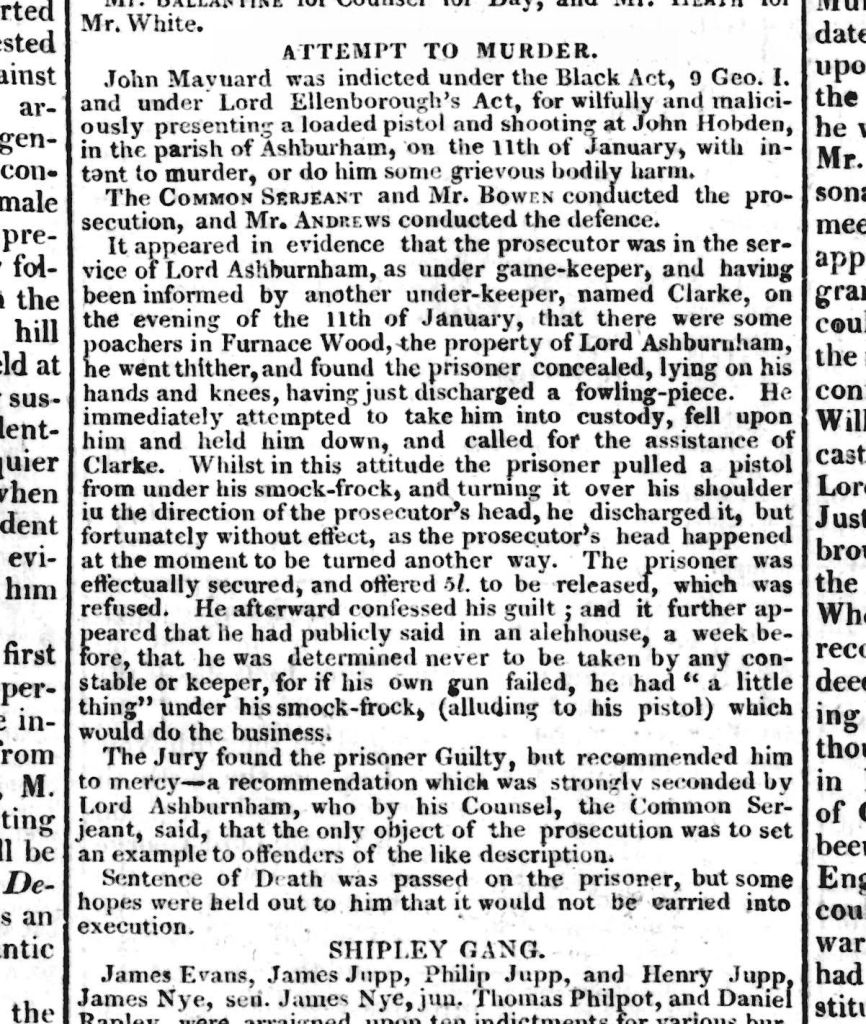
A few months after their last child is born, John Edwards Maynard appears in a news article from the Morning Advertiser printed in London and dated March 20, 1818 which is where his life story takes a tragic turn.
According to this news article discovered by my distant cousin, Robert Waters, on January 11, 1818 John was caught poaching on the estate of Lord Ashburnham in Sussex, England. While resisting apprehension, John fired a shot over his shoulder, narrowly missing a man. After his arrest, the news article noted that John offered 5L to be set free. According to fellow researcher, Robert Waters this was the ‘old way of saying £5 or five pounds, which was more than one years wages(!)’. John was refused and eventually plead guilty. For the transgression, he was sentenced to death.
His sentence was subsequently reduced to spending the rest of his ‘natural life’ in the penal colonies of Australia and in May 1818, leaving behind a wife and four children, one still an infant, he was transported to Portsmouth, Hampshire, England where he was held in bondage on a ship, the General Stuart, in the harbor. In July 1818, the ship set sail for Australia, arriving late December 1818. John was 33 years old.
Upon arrival in Australia, the paper trail reveals he was assigned hard labor via the penal colonies in the agricultural areas of Mintos, New South Wales. This would have included cutting brush, digging ditches, and building roads. By all accounts, this was backbreaking and dangerous work.
In 1821, about 2-1/2 years into his sentence, there is a notation in the New South Wales Colonial Secretaries’ accounts that John is now part of the convict crew at Grosse Farms. In 1823, he is located in Liverpool, New South Wales. In 1825, John is about 39 years old and he has again been relocated, this time to another penal colony in Horsley, New South Wales, Australia.
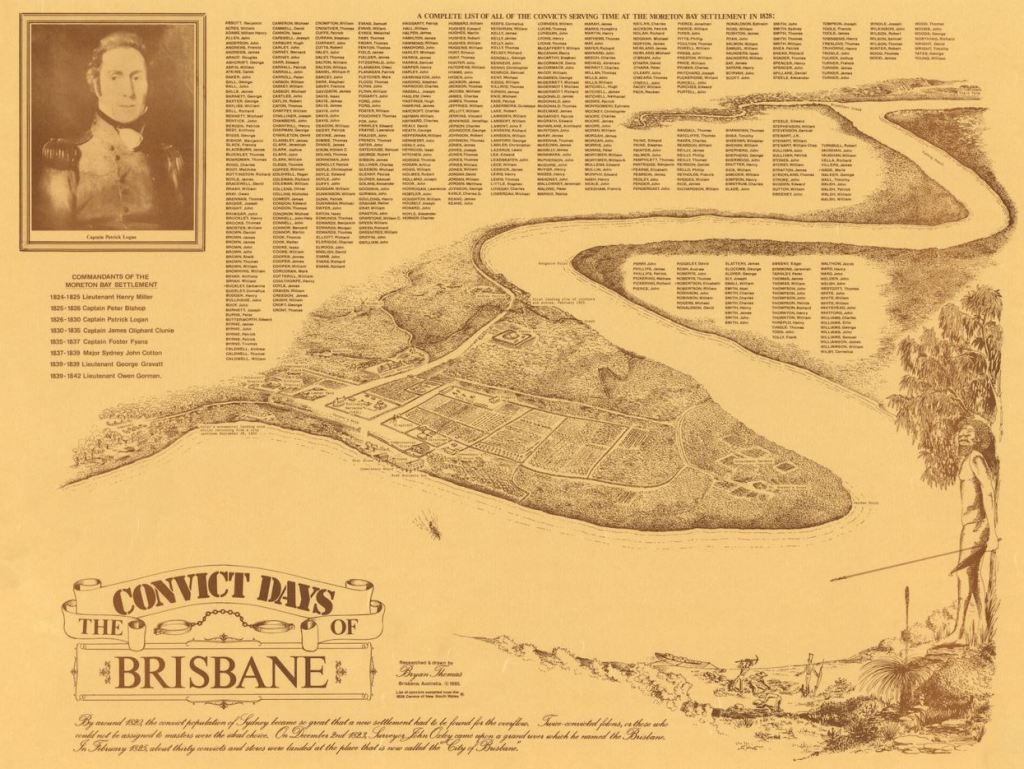
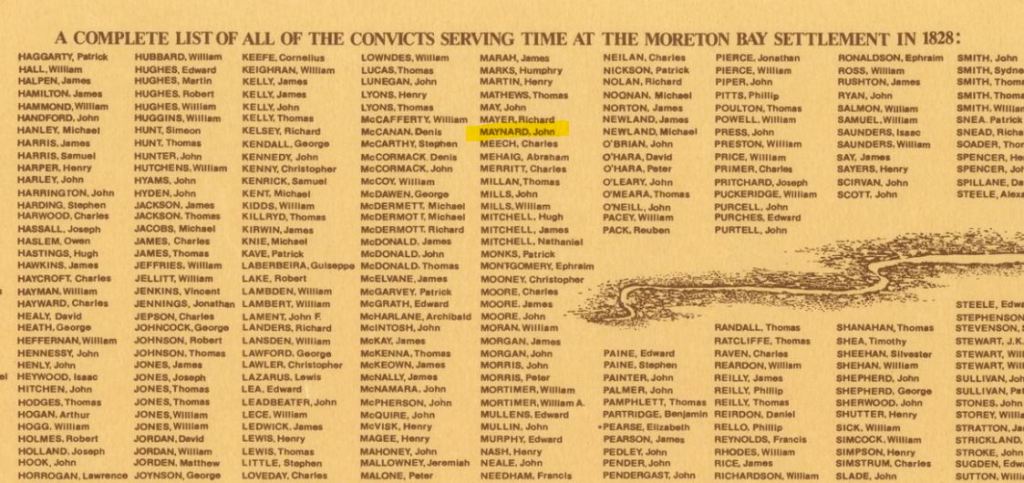
In 1828, John is listed in the New South Wales census as a convict in Moreton Bay penal colony, Queensland, Australia. After much research, including assistance from the Queensland library, we found documentation that indicated John had, at some point after his arrival in Australia, committed a second offense that precipitated his relocation to the dreaded Moreton Bay colony. One document recorded that John had been caught ‘stealing a fowling piece’ (a gun used for shooting small game, mainly birds).
Reading history on the lives of convicts in this colony was grim and horrifying. At the time John was living at the Moreton Bay penal colony, the prison was under the command of Captain Patrick Logan who was widely known for severe and often deadly punishment of convicts.
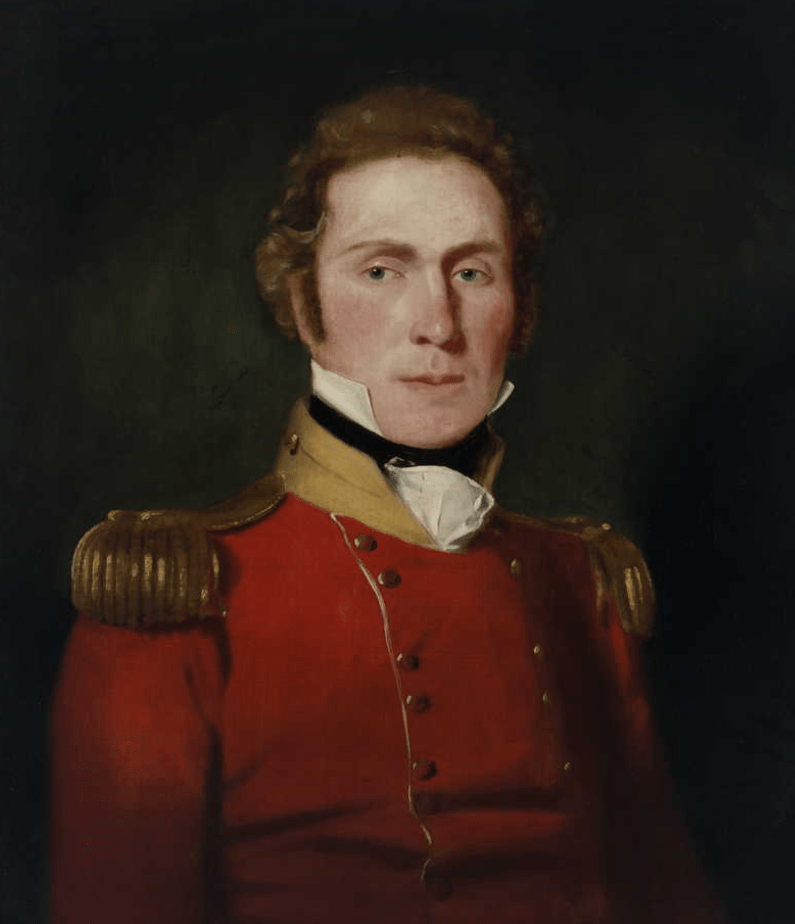
It should also be noted that, according to the blog of author, Michael Murphy:
“The history of disease at Moreton Bay can be categorized into two eras. The first era spans from the beginning of the settlement until 1830 and is charactarised by rampant disease and unsustainable population growth, leading to significant deaths and incredibly low standards of living. This can be particularly observed through the summer of 1828-1829, in which 220 convicts died.”
John died in Moreton Bay in January 1829 at the age of 42 without ever returning to England. The research assistants at the Queensland library were unable to locate any documents that recorded his cause of death which, they assured me, was not uncommon for convicts.
Meanwhile back at home in England, his wife Sarah (Morfey) Maynard raised their four children and in 1827 at the age of 44, Sarah gave birth to another child, a son listed in baptismal records as William M. Kenward. The baptismal record from April 1827, Ashburnham, Sussex, England is interesting in that, of all the babies baptized, Sarah Maynard is the only one listed without a husband. Also, the baptism is listed that it was conducted ‘privately’. She is still married to John Edwards Maynard who had been in various Australian penal colonies since arriving in 1818 and the record shows that this baby has a surname of ‘Kenward’.
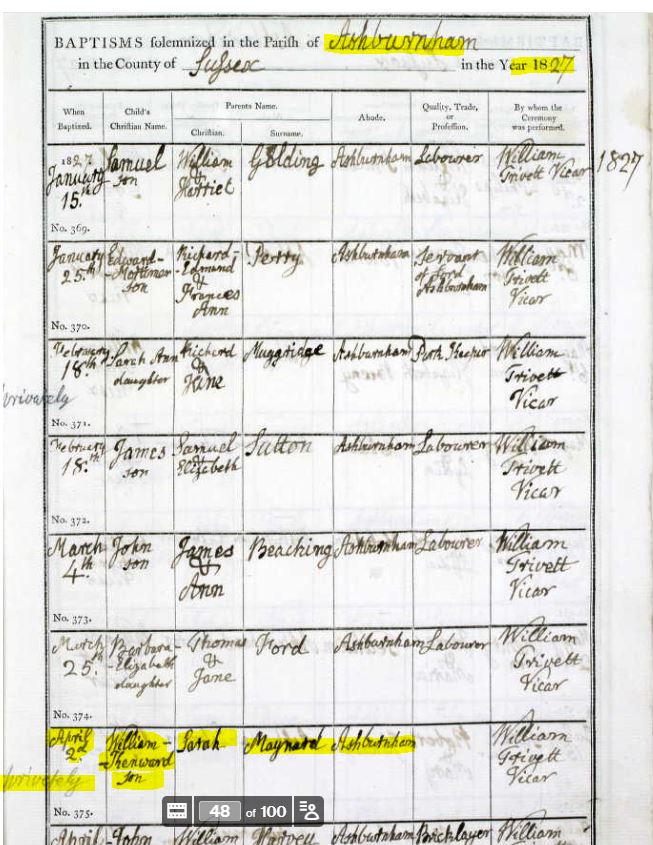
The following year, in December 1828 Sarah (Morfey) Maynard and John Kenward (father of baby William) travel to London and are married in a church not within the Ashburnham parish. John is a 35-year old widower with four children. Sarah is 45 at the time of her second marriage.
It should be noted that at the time of Sarah’s marriage to John Kenward, although she has presented herself as a widow on the marriage license, her first husband John Edwards Maynard is still alive. Sarah and John Kenward marry in December 1828; John Maynard does not die until January 25, 1829. The trip to a church in London may (or may not) have been strategic as they would have been unknown there and likely not questioned versus getting married in their parish.
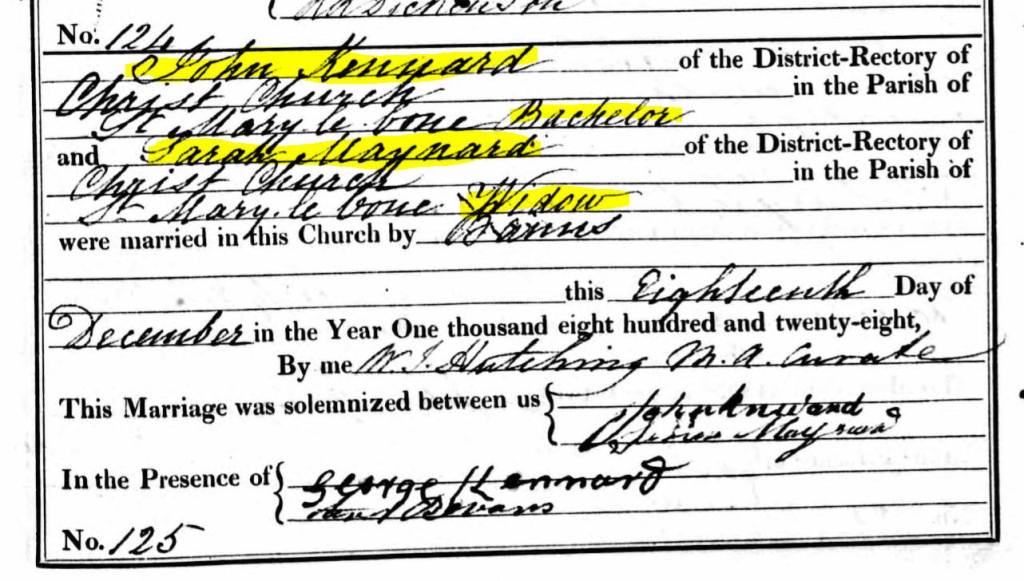
On the marriage record we see the signatures of John Kenward and Sarah Maynard which indicates they were both literate.
In June 1831, Sarah, her second husband, John Kenward, and their blended family immigrate to America on the ship ‘Hannibal’, settling first in Herkimer County, New York where my research shows several members of John’s family had settled after their arrival at an earlier date.
Sometime between the 1850 Federal census where the Kenwards are noted as living in Ostsego, Springfield, New York and 1856, the Kenward’s and Sarah’s children, Jonathon Maynard, Thomas Maynard (with his wife Caroline (Coleman) Maynard and their two children) and Martha Maynard, move ‘west’ to Macon, Lenawee County, Michigan.
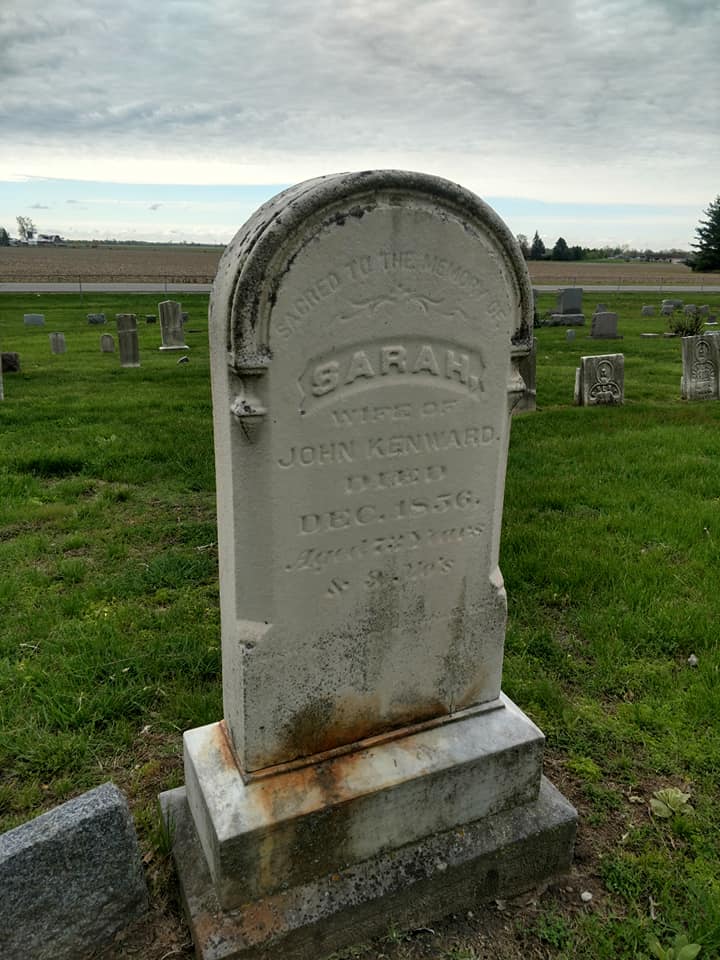
Sarah dies in 1856 at the age of 73 years and is buried in Lake Ridge Cemetery, Macon, Lenawee County, Michigan. Next to her grave are headstones of her son, Thomas Maynard (my 3X great grandfather), and Thomas’ wife Caroline (Coleman) Maynard (my 3X great grandmother).
John Kenward outlives his wife and after her death, he moves to Kalamazoo, Michigan where a city directory indicates he is living with his and Sarah Maynard’s son, William M. Kenward. John Kenward dies in Kalamazoo, Michigan in May 1878 at the age of 84 years, 22 years after Sarah died.
I would be remiss if I didn’t acknowledge Robert H. Waters who, after we connected on Ancestry, walked the journey with me and was instrumental in securing documents and information that had yet been undiscovered, in databases that I was not able to access. His patience with my flurry of emails and never-ending questions and theories is deeply appreciated.
Robert researched the Maynard line (one which we connect via DNA as distant cousins) for years so his input and advice has been invaluable. Without him, it is unlikely I would have uncovered the story of John Edwards Maynard and his life in the penal colonies.
He also added some interesting family history that is worth noting about John Edwards Maynard’s paternal grandfather:
“Thomas’s wife, Frances Edwards, was the daughter of John Edwards (he was a Gentleman but later became an Esquire!) and he is the reason why “John Edwards” has appeared as first names in nearly every generation of Maynards. This is because he was appointed by the King in 1745 as Sheriff of Sussex. See The London Gazette for Jan 31 to 4 Feb 1745.”

 Tiny Acorns & Mighty Oaks
Leave a comment