
Genealogy has a way of taking us places we never expected to go.
I’ve spent years researching my Manley ancestors, tracing them from the early Massachusetts colonies through their migrations to New York and eventually, Lenawee County, Michigan. Along the way I’ve uncovered the details that bring a family history to life – where they lived, whom they married, the land they owned, and the families and communities to which they were connected.
But several years ago I found something considerably more difficult.
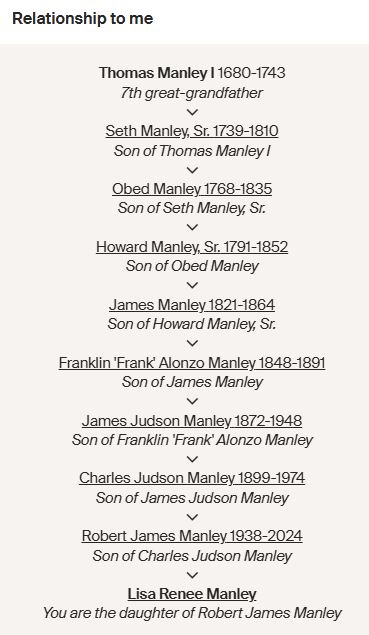
My 7X great grandfather, Thomas Manley, owned an enslaved person.
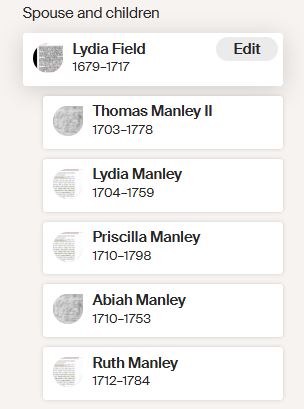
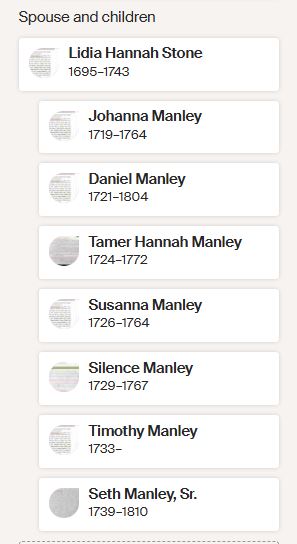
Thomas Manley was born in Weymouth, Massachusetts in 1680, the son of William and Rebecca Manley. His father, William, was recorded as the second settler of Easton, Massachusetts, Clement Briggs having the distinction of being the first. Thomas himself settled in Easton, Massachusetts where he raised his family and died in 1743.
While researching Thomas, I discovered a reference to an enslaved boy named George.
In 2021 I contacted the Easton Historical Society hoping to learn more. Historian Frank Meninno replied, in part:
“Great hearing from you! William Manley is indeed one of our first two settlers here in Easton. When our history was written in 1886 there were descendants of both Briggs and Manley living here and they evidently agreed as to who was first – but I think it was a pretty close race to settle.
Easton, as did just about all new England towns, has a history of slavery and indentured servants. Our book History of Easton, Massachusetts, by William Chaffin, documents a number of slaves in town, and paints a picture of them being better treated than those in the south. In Easton, it seems they were part of the household, living with their masters, attending church with them. Not to gloss over it, but unfortunately, not all of our history is wonderful, and many suffered the indignity of slavery. As far as George goes, we do not know any more about him. Some of the former slaves stayed in Easton, with their family, or eventually getting their own land. Others move on with no record left behind. The clues to what happened to George may lie with whomever the executor of Thomas Manley’s will was, and perhaps that might show if George was given to another person in the family, and if that person freed him. Those documents are kept at our Bristol County Registry of Deeds, which is still closed due to the pandemic.”
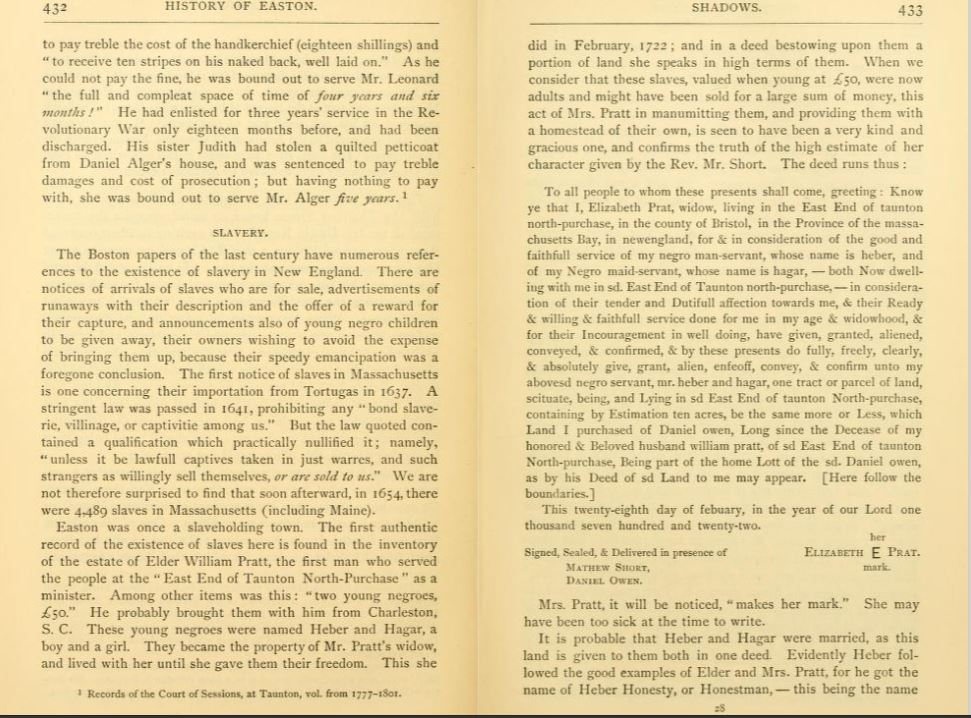
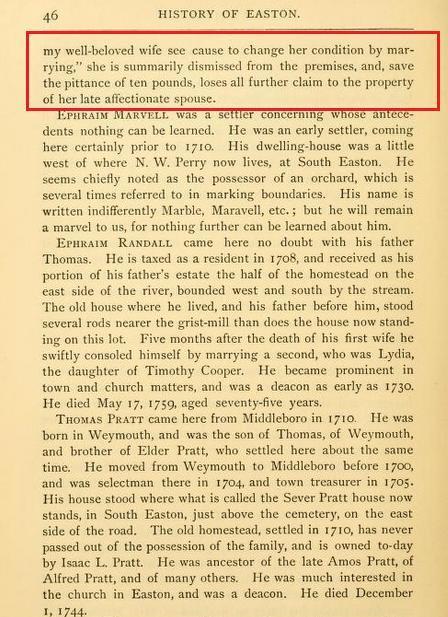
Meninno then directed me to William L. Chaffin’s 1886 book History of the Town of Easton, Massachusetts and it’s remarkable section documenting slavery in the town.
Chaffin begins that section with a sentence that is startling in it’s simplicity.
“Easton was once a slaveholding town.”
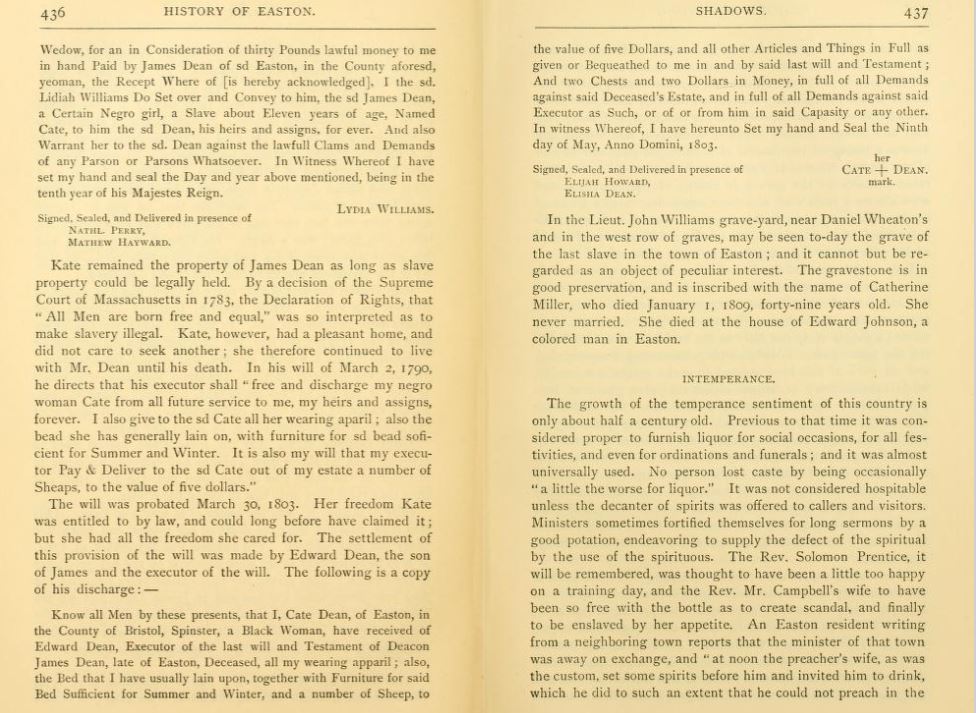
The pages that follow document some of the enslaved men, women, and children, who lived there. Their names included Heber, Hagar, Affaba, Antony, London and Kate.
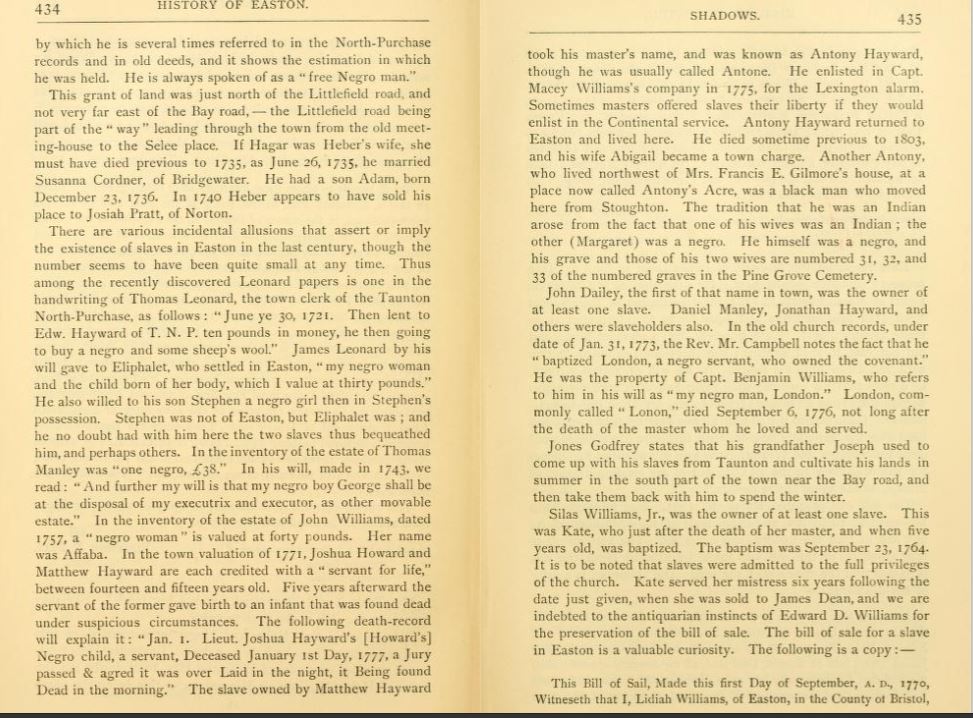
And then, on page 434, I found the Manley name.
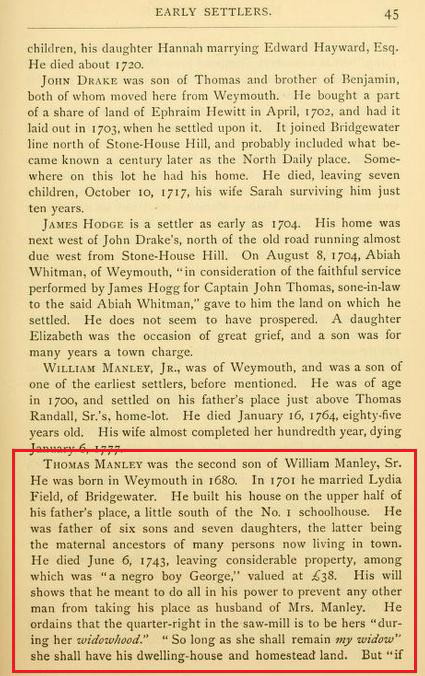
Chaffin records that the inventory of Thomas Manley’s estate contained “one negro“ valued at £38. Even more disturbing is the language of Thomas’ own will, written in 1743:
“And further my will is that my negro boy George shall be at the disposal of my executrix and executor, as other movable estate.“
George was a human being.
Yet in my ancestor’s will, he was treated as moveable estate.
The probate record itself confirms that Thomas’ 1743 will named a “negro boy named George”, along with Thomas’ wife and children.
I had initially thought that George might represent an isolated occurrence within my Manley research. But while recently re-reading the pages the Easton historian had sent me, I noticed something I had either forgotten or failed to notice the first time.
On the following page, Chaffin writes that Daniel Manley was also a slaveholder.
So George was not an isolated connection between the Manley family and slavery.
That realization changes the way I look at this piece of my family history.
Slavery is often associated almost exclusively with the American South, however, these records are a reminder that slavery existed in colonial New England as well. Chaffin documented enslaved people being bought, sold, inherited, and listed as property in Easton. He also record the lives of some after they became free.
But George’s story remains frustratingly incomplete.
I know when Thomas Manley was born. I know his parents, his wife, and his children. I can follow his descendants through generation after generation until eventually his story reaches mine.
I cannot do that with George.
I don’t know his parents.
I don’t know where he was born.
I don’t even know exactly how old he was when Thomas called him a ‘boy’.
I don’t know how Thomas acquired him.
And I don’t know what happened to him after Thomas died.
When I contacted the Easton Historical Society, I was told that clues might someday be found in the records surround Thomas’ estate – perhaps revealing whether George was transferred to another member of the family or eventually obtained his freedom.
I hope someday I find that answer.
Genealogy isn’t only about discovering ancestors we can be proud of. If we’re going to tell their stories, I believe we have to tell the uncomfortable parts too.
Thomas Manley was my 7X great grandfather.
He owned another human being.
And somewhere in Easton, nearly three hundred years ago lived a boy whose life crossed my family’s history under circumstances he did not choose.
His name was George.
For now, that is almost all I know about him.
But it is enough to make sure he isn’t forgotten.

 Tiny Acorns & Mighty Oaks
Leave a comment