When my husband, bearing a very Italian surname, took a DNA test a few years ago we anticipated he’d be overwhelmingly Italian. His paternal grandfather, Florindo Lanciano (1904-1971) had all the hallmarks of his Italian heritage – the lifelong nickname of ‘Rocky’, darker skin tone, black hair, and an-all Italian line stretching back decades, all the way to Sturno, Italy. We even named our own sons with Italian first names.
Our first clue that Ireland was in the gene pool should have been the fact that my father-in-law, Frederick “Fred” Lanciano (1924-2007), sported red hair and fair skin in his youth.
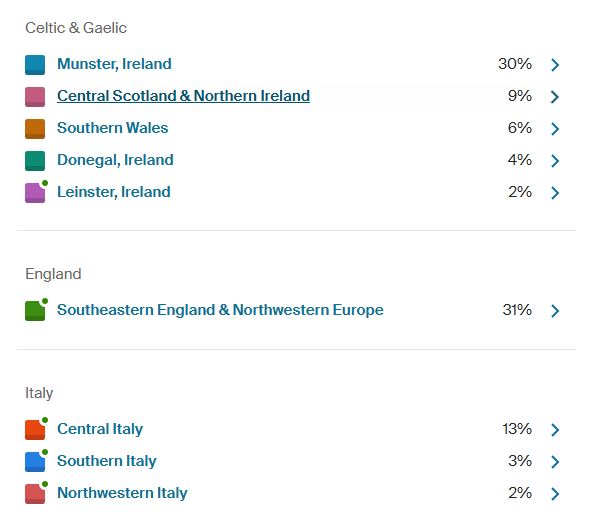
However, what we didn’t expect was just how much Celtic and Gaelic ancestry my husband had inherited. With Ancestry’s current estimate, 51% of his DNA falls within its Celtic and Gaelic regions – including 36% specifically assigned to regions of Ireland – compared with just 18% Italian.
Insert plot twist.
On my husband’s paternal side, one branch seemed unmistakably Italian, his grandfather, Florindo “Rocky” Lanciano. But then there’s Rocky’s wife, Catherine Marie ‘Kitty’ Jones (1903-1990), my husband’s paternal grandmother.
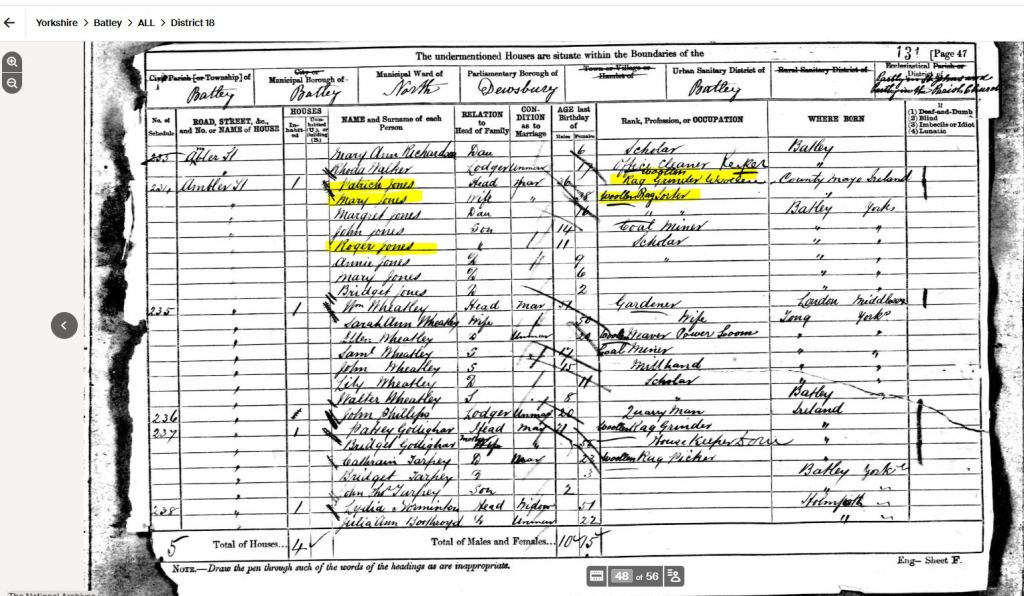
Researching Kitty’s line over the years, I’ve been able to piece together her Irish heritage, starting with her father, Robert “Roddy” Jones (1870-1914) and grandfather, Patrick Jones (1845-1909) who was born in County Mayo, Ireland.
Patrick Jones, my husband’s 2X great grandfather, was born to John Jones and Margaret (surname unknown as of this writing) in March 1845 in Ireland. He was born just as the Great Potato Famine was beginning. Mayo would become one of Ireland’s hardest-hit counties, losing roughly 29% of its population between 1841 and 1851 through death and emigration. Patrick’s earliest years, therefore, unfolded against an extraordinary period of hunger, disease, displacement and migration. Whether the Famine directly prompted his eventual move to Yorkshire, I cannot yet document, but it certainly formed the backdrop of his childhood.
It appears, based on England census records, that sometime between Patrick’s birth in 1845 and 1865, Patrick moved to Batley, Yorkshire, England. It is unclear, based on my current research, if John Jones moved his family from County Mayo, Ireland to England or if Patrick, his son, came alone as a young man.
Jones, being a very common name in Ireland, has been difficult to trace and while I can find a myriad of ‘John Jones’ who emigrated to England, I cannot, with full confidence, determine if the entire Jones family of my husband’s line left Ireland at that point.
What I do know is that John and Margaret’s son, Patrick, can be found in records in Batley, Yorkshire, England by 1865 and he marries Mary Lynch (1843-1906) who was also born in County Mayo, Ireland. Their first child, Margaret, is born the same year.
In the 1871 England census, Patrick is recorded as 30 years old and he and his wife, Mary, are living in Yorkshire with four children – the youngest at that time is my husband’s great grandfather, Robert ‘Roddy’ Jones (1870-1914). Patrick’s occupation is listed as a ‘rag grinder’.
A ‘rag grinder’ was part of Batley’s enormous shoddy industry, in which old woolen clothing and rags were recycled into new textile fiber. Patrick would have fed rags into a powerful grinding machine – appropriately named the ‘devil’ – whose rapidly moving teeth tore the fabric back into fibers that could later be spun and woven again.
It was dirty, dusty, and physically demanding factory work. His occupation places the Jones family firmly among Batley’s industrial working class; while the census alone cannot tell us exactly how poor they were, this was wage labor rather than a prosperous or professional occupation.
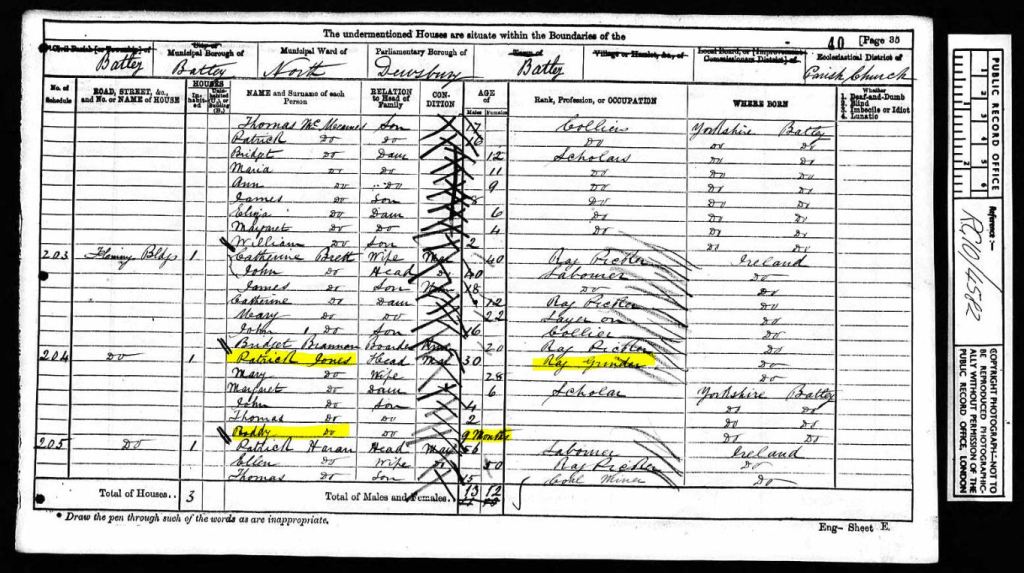
By the 1881 census, both Patrick and Mary were working in the woolen industry: Patrick as a ‘rag grinder’, while Mary was recorded as a ‘rag worker’. Their 14-year-old son, John Jones, has already entered the workforce as a ‘coal miner’. Roddy Jones is listed as a ‘scholar’. The younger daughters are not noted with a status/occupation.
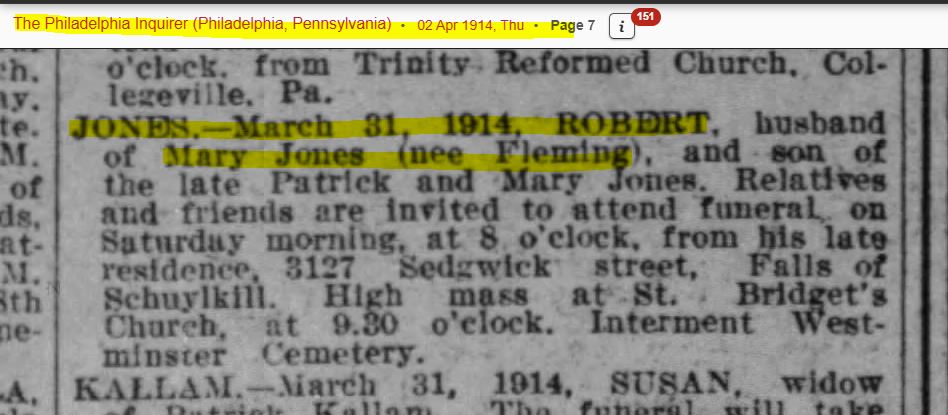
In 1888, Patrick and Mary’s son, 18-year old son, Roddy Jones, my husband’s great grandfather, immigrated to America settling in Philadelphia, Pennsylvania and in 1890, at the age of 20, Roddy marries Welsh-born Mary Fleming (1868-1932) who was two years his senior.
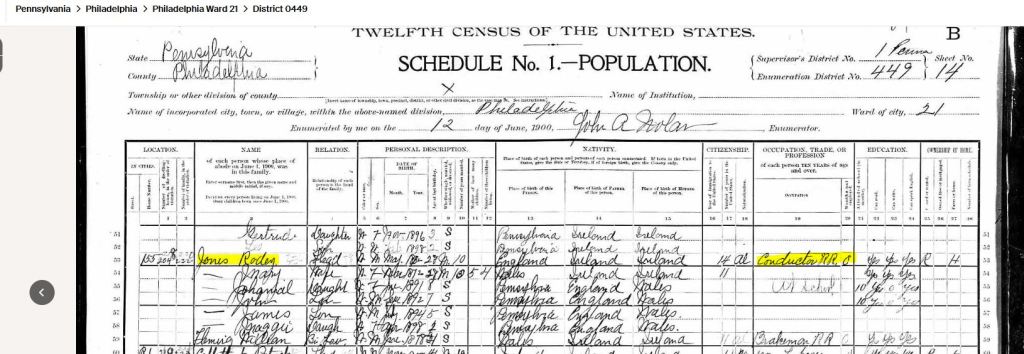
Two years after their arrival in America, in the 1900 Federal census for Philadelphia, Pennsylvania, Roddy’s occupation is listed as a ‘conductor railroad’. Mary’s brother, William Fleming, was also living in the household and working as a ‘railroad brakeman’. Both brothers-in-law were, therefore, employed in the railroad industry, although the census does not establish whether they worked for the same company. Roddy and Mary now have four children.
In the 1910 census, Roddy’s occupation is listed as a ‘fireman’. Roddy and Mary now have nine children, including twins Catherine “Kitty”, my husband’s grandmother, and Regina. Brother-in-law, William Fleming, is not listed in the household in 1910.
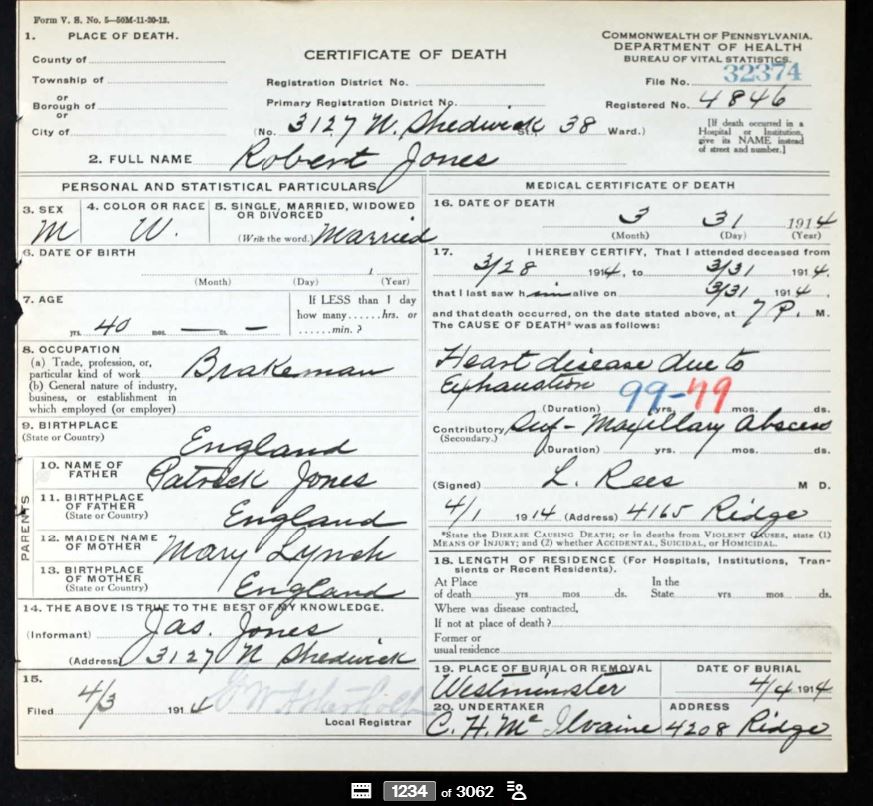
In 1914, tragedy struck the Jones family with Roddy’s untimely death at just 40 years old. His death certificate lists the primary cause as “heart disease due to exhaustion”, with a “sub-maxillary abscess” as a contributory condition. The latter refers to a serious abscess beneath the lower jaw, often associated with an infection of a tooth, surrounding tissues or salivary structures. In an era before antibiotics, an infection in this area could become extremely serious and place tremendous strain on the body.
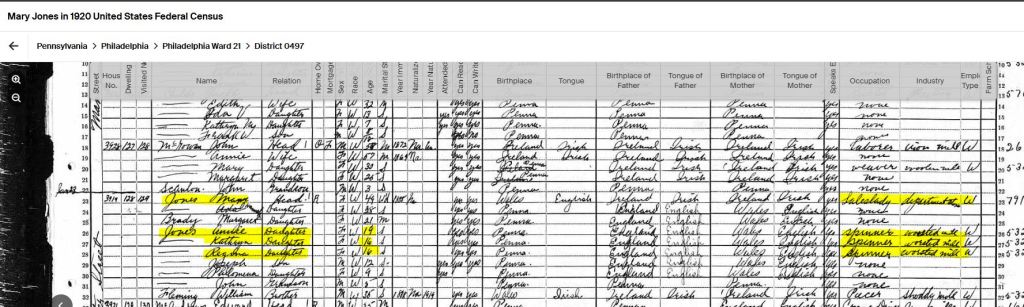
After Mary was widowed, her brother, William Fleming returned to their home, likely to assist with support. In the 1920 census, six years after Roddy’s death, Mary is noted as working as a ‘saleslady’ at a department store. Her youngest child is 5 years old, her oldest 19. The three older daughters, Margaret, and twins Catherine “Kitty” and Regina, all teenagers, are working as ‘spinners’ at the worsted wool mill.
Working as a spinner in a worsted mill meant tending machinery that drew out prepared wool fibers, twisted them into yarn and wound the finished yarn onto bobbins. Spinners had to watch numerous moving strands, join broken threads and keep the machinery supplied and running. It was repetitive industrial work requiring constant attention and long periods on one’s feet. For Kitty and her sisters, still teenagers, their mill wages were very likely an important part of supporting their widowed mother’s household.
Three years after the 1920 census, in 1923, 20-year-old, Kitty married 19-year-old Florindo “Rocky” Lanciano (1904-1971) and the two family lines – Irish and Italian – finally merge.
In 1920, Kitty and Rocky were both recorded in the Federal census as young factory workers, although they were living in different parts of Philadelphia. Kitty was at 3919 Dexter Street in Roxborough, working as a spinner in a worsted wool mill, while Rocky lived with his family at 2943 Westmont Street in North Philadelphia and worked as a laborer in an oilcloth factory. Exactly how the two met remains one of those family-history mysteries I’d still love to solve.
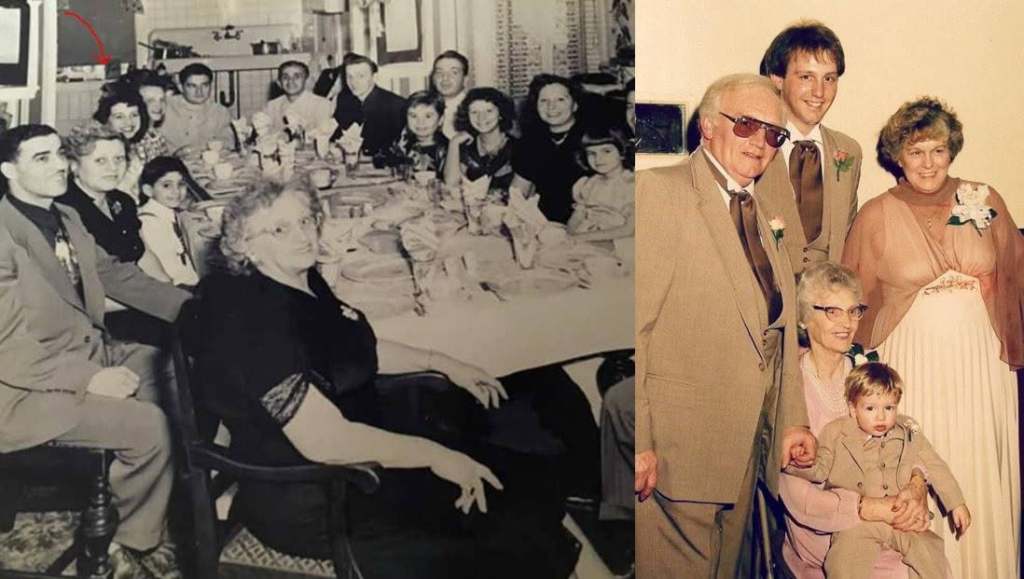
The Lanciano surname told me one very real part of my husband’s story – but it wasn’t the whole story. Behind that Italian name were also Irish-born ancestors from County Mayo, years spent in the mills of Yorkshire, a young man crossing the Atlantic for Philadelphia and a widowed mother and her children working to keep a household going. In 1923, those histories finally came together when Kitty Jones married Rocky Lanciano.
A century later, a DNA test simply pointed me back toward what the records had been waiting to tell me all along, family history is rarely as simple as the name we inherit.


Leave a comment