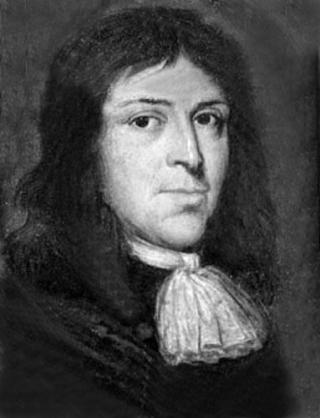
The Reverend Samuel Parris, the girls whose accusations ignited a witchcraft panic, and the Manley connection that brought this history to my doorstep.
Every family tree has its share of surprises. Some ancestors leave behind remarkable achievements, others lead ordinary lives that history has largely forgotten, and occasionally, one turns up whose name is forever associated with a dark chapter in American history.
As Halloween approaches, I thought it would be the perfect time to share one of the more haunting discoveries in my genealogical research.
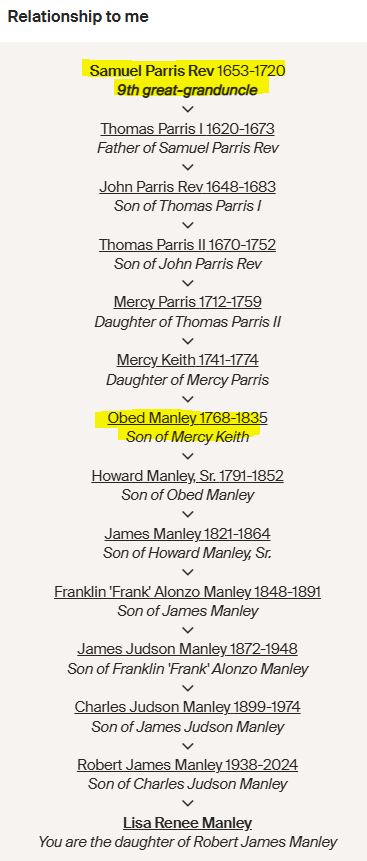
My 9X great granduncle was the Reverend Samuel Parris (1653–1720), the Puritan minister whose household became the starting point of the infamous Salem witch trials of 1692.
Yes, those Salem witch trials.
And the connection comes through my paternal Manley family, a line that has been the subject of several of my recent genealogical discoveries.
But before we travel to Salem, Massachusetts, we need to go back a little further, to England, where the Parris family story begins.
Two Brothers, Two Very Different Paths
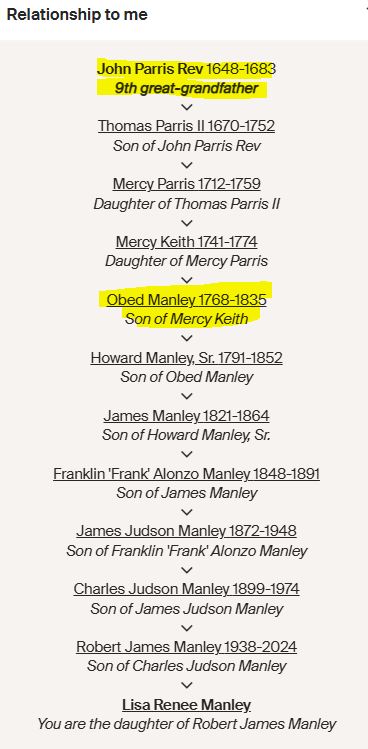
My connection to Samuel Parris comes through his older brother, the Reverend John Parris (1648–1683), my 9X great grandfather.
The brothers were sons of Thomas Parris, an English merchant whose business interests extended to Barbados in the Caribbean.
According to a historical account of Samuel’s early life, the brothers were educated in England, but their paths eventually diverged.
John remained in England, where he became a minister in Ugborough, Devon. Samuel, meanwhile, traveled to Barbados, where his father had maintained business interests.
When their father died in 1673, John reportedly inherited the family’s English and Irish properties, while Samuel assumed responsibility for the family’s holdings in Barbados.
Samuel eventually returned to Massachusetts, where he married Elizabeth Eldridge and began pursuing a career in the ministry.
By 1689, he had become the minister of Salem Village, a small Puritan community in colonial Massachusetts.
Neither brother could have imagined that Samuel’s name would become permanently associated with one of the most notorious episodes of mass hysteria in American history.
Something Sinister in Salem Village
In January 1692, strange things began happening inside the home of Reverend Samuel Parris.
His nine-year-old daughter, Elizabeth, known as Betty, began experiencing frightening and unexplained symptoms. She made unusual noises, behaved erratically, and appeared to suffer from mysterious fits.
Soon, Samuel’s eleven-year-old niece, Abigail Williams, who also lived in the household, began displaying similar symptoms.
In a deeply religious Puritan society, where belief in the Devil and witchcraft was widespread, these behaviors caused enormous alarm.
When prayer and medical remedies failed to resolve the girls’ symptoms, suspicion turned toward something supernatural.
The girls were believed to be bewitched.
Before long, other young girls in the community began reporting similar experiences.
And then came the accusations.
Tituba: The Enslaved Woman at the Center of the Accusations
Living in the Parris household was an enslaved woman named Tituba, along with another enslaved person known as John Indian.
Samuel Parris had connections to Barbados, and historians believe Tituba may have come from an Indigenous community in South America or the Caribbean, although her precise origins remain uncertain.
On February 29, 1692, warrants were issued for the arrest of three women accused of practicing witchcraft: Sarah Good, Sarah Osborne, and Tituba.
All three were vulnerable members of the community, and Tituba, as an enslaved woman, had particularly little power to defend herself.
Initially, Tituba denied practicing witchcraft. But under extraordinary pressure, she confessed and described frightening encounters with supernatural beings, including claims that other witches were operating in the community.
Rather than ending the accusations, her confession helped fuel them.
One allegation of witchcraft became another, and another, until the entire community seemed consumed by fear and suspicion.
Historical accounts also allege that Samuel Parris physically abused Tituba to force her confession.
Tituba survived the trials, but her suffering did not end there.
She remained imprisoned for more than a year. When Parris refused to pay her jail fees, she was eventually sold to another enslaver to cover the cost of her imprisonment.
After that, she largely disappeared from the historical record.
Of all the people connected to Samuel Parris, Tituba’s story is one of the most heartbreaking. She was enslaved, accused, imprisoned, and ultimately sold, with virtually no control over her own fate.
The Witch Trials Spiral Out of Control
What began with two young girls in a minister’s household quickly spread throughout Salem Village and the surrounding communities.
Neighbors accused neighbors. Friends turned against friends. Long-standing disputes and personal grievances became entangled with allegations of witchcraft.
Those accused faced imprisonment, frightening interrogations, and trials in which claims of invisible spirits were treated as evidence.
By the time the hysteria subsided, 19 people had been executed by hanging, one man had been pressed to death, and several others had died in jail.
Hundreds had been accused, and many innocent lives were permanently damaged.
Reverend Samuel Parris played a significant role in the crisis, both as the father and uncle of the first two afflicted girls and as a minister whose sermons reinforced fears of the Devil’s presence in Salem.
The witch trials eventually ended, but their consequences followed the community for generations.
Samuel himself became an increasingly controversial figure.
He eventually left Salem Village in 1697 and continued his ministry elsewhere before dying in Sudbury, Massachusetts, in 1720.
More than three centuries later, his name remains inseparable from the events of 1692.
An Interesting Question About Abigail Williams
One particularly intriguing aspect of this family connection concerns Abigail Williams.
Historical accounts consistently identify Abigail as Reverend Samuel Parris’s niece. She was living in his home when the accusations began and became one of the principal accusers during the witchcraft crisis.
But here is where genealogy becomes especially interesting.
The identities of Abigail’s parents have never been conclusively established.
Although Samuel’s older brother, Reverend John Parris, is my direct ancestor, there is currently no reliable evidence establishing Abigail as John’s daughter.
That means I can document my relationship to Samuel through the Parris family, but I cannot yet establish precisely how Abigail Williams fits into my ancestral line.
And as anyone who has spent time researching family history knows, sometimes the unanswered questions are just as fascinating as the discoveries themselves.
Bringing the Story Back to the Manley Family
So how does a Puritan minister involved in the Salem witch trials connect to a woman born into the Manley family nearly three centuries later?
The answer lies in a series of marriages and generations that eventually brought the Parris surname into my paternal ancestry.
My 9X great grandfather, Reverend John Parris, had a son named Thomas Parris II (1670–1752).
Thomas’ daughter, Mercy Parris (1712–1759), married Mark Keith (1710–1780).
Their daughter, Mercy Keith (1741–1774), married Seth Manley Sr. (1739–1810).
And it is through their son, Obed Manley (1768–1835), my 5X great grandfather, that my own direct Manley ancestry continues.
From Obed, the line descends through Howard Manley Sr., James Manley, Franklin Alonzo Manley, James Judson Manley, Charles Judson Manley, and finally my father, Robert James Manley (1938–2024).
And then, me.
One small branch of a much larger family tree, stretching across more than three centuries.
What I find particularly fascinating is that Reverend John Parris remained in England, while his brother Samuel became a central figure in one of colonial America’s darkest episodes.
Yet generations later, John’s descendants crossed the Atlantic, established families in Massachusetts, and eventually became part of the Manley family history.
Had I not been researching my paternal ancestry, I might never have discovered this connection.
History Is More Than Names and Dates
One of the reasons I enjoy genealogy so much is that it transforms historical events from distant stories in textbooks into something much more personal.
The Salem witch trials are familiar to most Americans. We have read about them in school, watched documentaries, and seen countless fictional portrayals of the hysteria that gripped the Massachusetts colony in 1692.
But discovering that my own 9X great granduncle stood at the center of those events gives the story an entirely different perspective.
It certainly doesn’t mean I admire his actions, nor does it mean I bear any responsibility for them.
It simply means that his story is part of the larger history of my family.
And that history includes both the people who suffered and the people who contributed to their suffering.
I think it is important to remember both.
The Salem witch trials were not merely a frightening episode from the distant past. They were a tragedy in which fear, religious extremism, suspicion, and the misuse of authority combined to destroy innocent lives.
Perhaps that is why their story continues to resonate more than 330 years later.
And while witches, ghosts, and haunted houses may be the stuff of Halloween entertainment, the real events in Salem were far more disturbing than any fictional ghost story.
Because the greatest danger in Salem in 1692 wasn’t witchcraft. It was what ordinary human beings became capable of doing when fear overcame reason.
And somewhere within that history, I discovered another branch of my Manley family tree.


Leave a Reply