Sometimes while analyzing my genealogy research I discover unexpected family connections hiding among the records. Generally these discoveries involve families whose paths crossed within the small communities of my own ancestral lines. However, I was surprised and delighted to discover that at least two of my family lines intersected geographically with one of my husband’s maternal ancestral lines during the mid-1800s in Clarkson, Monroe County, New York.
And considering the occupations of two of our ancestors, I suspect their paths may have crossed in more ways than one.
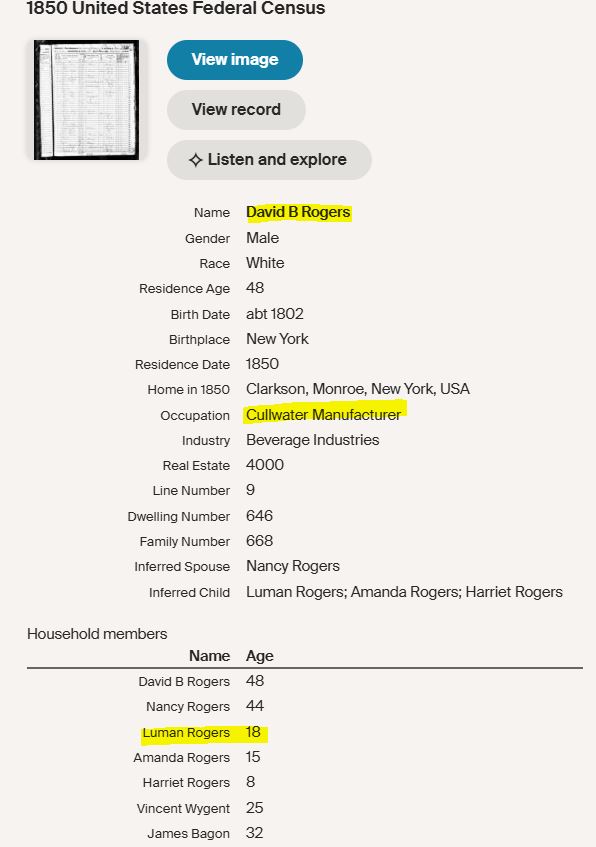
My husband’s maternal 3X great grandfather, David B. Rogers (1802-1887) was born in New York in 1802 and was living in Clarkson by 1850. Although I have yet to locate a marriage record for David or establish the maiden name of his wife, Nancy, their eldest son, Luman Ray Rogers, was born around 1831.
As mentioned in a previous blog, Luman would eventually marry Mary Eliza (Lydia) Wall, daughter of the noted Allegheny County, Pennsylvania, landscape painter, William Coventry Wall.
The 1850 United States Federal Census lists David’s occupation as a Cullwater Manufacturer. Unfamiliar with this occupation, I investigated further and determined that the transcription likely should read Cultivator Manufacturer.
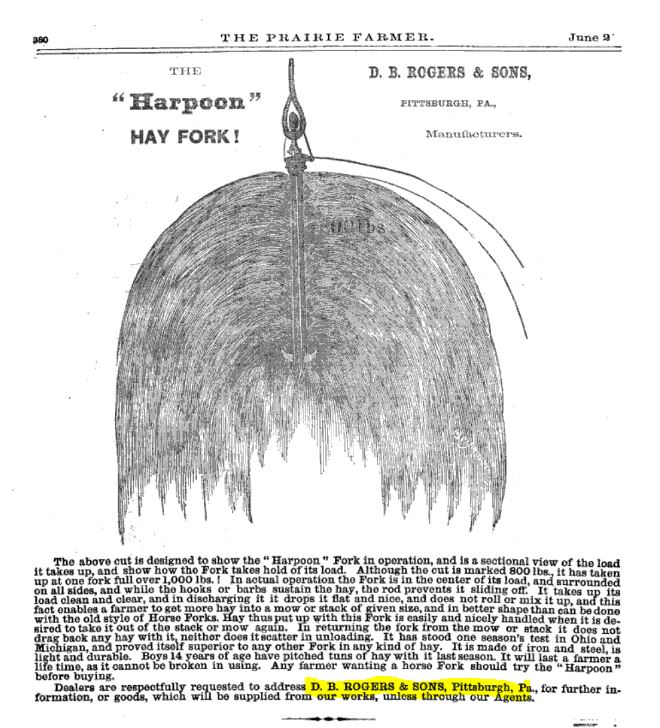
This interpretation is consistent with other historical documentation I’ve uncovered concerning David’s work manufacturing and inventing agricultural implements. Among the products associated with his business was the Harpoon Hay Fork, an innovative device designed to make lifting and storing hay considerably easier.
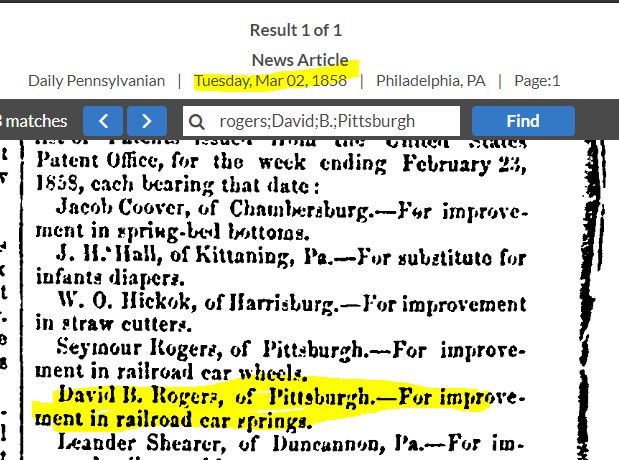
David’s brother, Seymour Rogers, was a blacksmith, and the two brothers collaborated on mechanical inventions. An 1858 newspaper article even identifies patents awarded to both men: Seymour for an improvement to railroad car wheels and David for an improvement to railroad car springs.
Sometime after the 1850 census, David, his family, and his brother Seymour relocated to Pittsburgh, Pennsylvania. It was there that my mother-in-law’s ancestral line would remain for several generations.
Meanwhile, another of my ancestral families was establishing its own history in Clarkson.
My 4X great grandfather, Leman N. Smith (1806–1888), appears in the 1850 Federal Census as a miller. Along with his brothers, Leman was involved in the ownership and operation of several mills throughout western New York, including Monroe and neighboring Orleans counties.
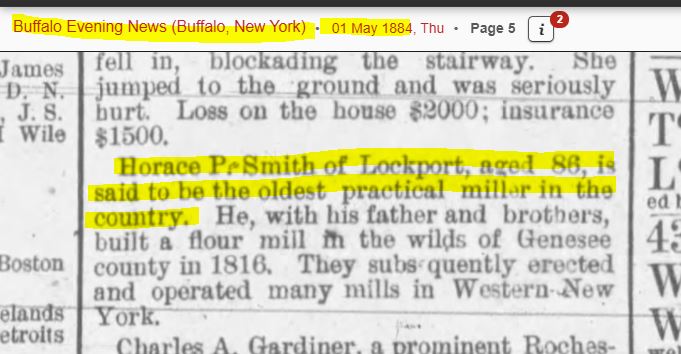
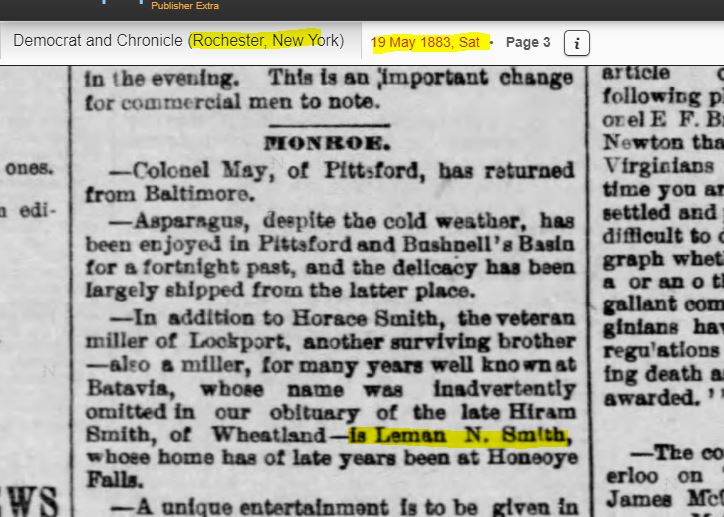
The Smith brothers were evidently well regarded in their profession. An 1884 newspaper article described Leman’s brother, Horace P. Smith, as possibly the oldest practicing miller in the country. Another article, published in 1883, identified Leman as a longtime miller who had been well known in Batavia before making his home in Honeoye Falls.
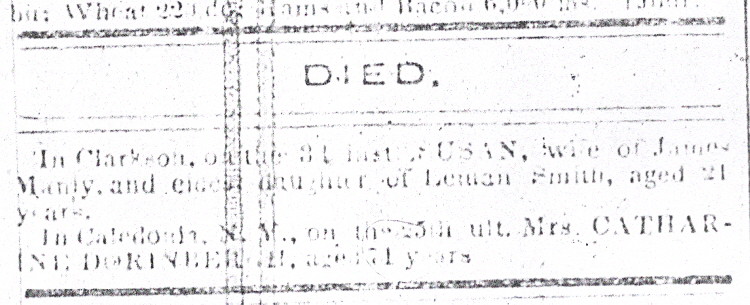
Leman’s daughter, Susan Smith (1829–1850), married my 3X greatgrandfather, James Manly (1821–1864), in 1847. Together, they had two children.
Tragically, Susan died in May 1850 at just 21 years of age, following complications associated with the birth of their second child, Edwin Smith Manly.
Her death left James with a two-year-old child and a newborn son. Edwin was subsequently raised by his maternal grandparents, Leman and Rachel Yale Smith, and eventually dropped the surname Manly, becoming known simply as Edwin Smith.
Now, here’s where the story becomes particularly interesting.
In 1850, Clarkson had a population of approximately 1,334 people, including children. It was a relatively small community, supported in large part by the agricultural economy of western New York.
Living within that community were two men whose descendants would eventually become part of the same family: David B. Rogers, my husband’s 3X great grandfather, and Leman N. Smith, my 4X great grandfather.
One manufactured agricultural implements. The other operated mills in a region where farming and grain production were important parts of everyday life.
Their occupations placed them within overlapping areas of the local economy. Farmers required equipment to cultivate and harvest their crops, while millers relied upon those crops for their businesses. Both men would have had reasons to interact with farmers, tradesmen, merchants, and other local business owners.
Is it possible that Leman purchased agricultural equipment from David Rogers? Could the two have conducted business together, crossed paths through mutual customers, or simply known each other as fellow businessmen in their small community? Could the Manly’s, most of whom were farmers, have interacted with David Rogers?
I have no documentation establishing a direct relationship between the two men, but the possibility is certainly intriguing.
And given the size of Clarkson and the nature of their occupations, I think it’s reasonable to suspect that they may have been acquainted.
What fascinates me most about genealogy is that our family histories rarely exist in isolation. Our ancestors lived and worked within communities, formed relationships, conducted business, and crossed paths with people whose significance to future generations they could never have imagined.
In 1850, David Rogers and Leman Smith could not possibly have known that, generations later, their descendants would marry and unite these two ancestral lines.
Perhaps they knew each other. Perhaps they even conducted business together. Or perhaps they were simply two men whose lives briefly overlapped in a small western New York community.
I may never uncover a document proving that they met, but I find something wonderfully fascinating about the possibility.
Long before my husband and I ever met, our family histories may already have crossed paths.
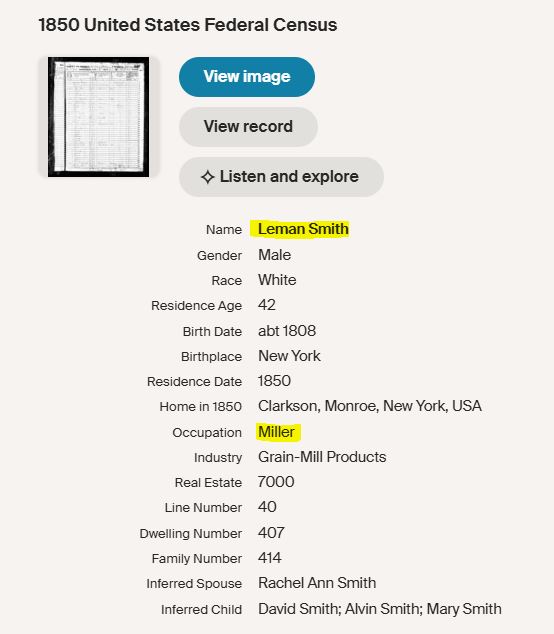
Page 53 of the 1850 Federal census for Leman Smith and family in Clarkson, NY. Leman’s daughter, Susan is not enumerated with the Smith’s as she was married three years prior in 1847 to James Manly. She dies at the age of 21 in May 1850.


Leave a Reply