
When I began researching Captain George Holmes Ghriest (1834-1917) for my husband’s family tree, I was shocked to discover just how much a seemingly insignificant decision made more than a century ago could have had an extraordinary impact on generations yet to be born.
Such is the life of my husband’s second great-grandfather, Captain George Holmes Ghriest, a steamboat captain in Pittsburgh, Pennsylvania whose fortunate absence from a doomed vessel in June 1858 may very well be the reason my husband is here today.
And remarkably, this story also involves one of America’s most celebrated authors, Mark Twain.
But I’m getting ahead of myself.
A Life on the Rivers
Born on May 20, 1834, in Pennsylvania, George Holmes Ghriest spent much of his working life navigating America’s great inland waterways.
During the nineteenth century, steamboats were essential to commerce and transportation, carrying passengers, merchandise, and agricultural products between communities along the Ohio and Mississippi rivers.
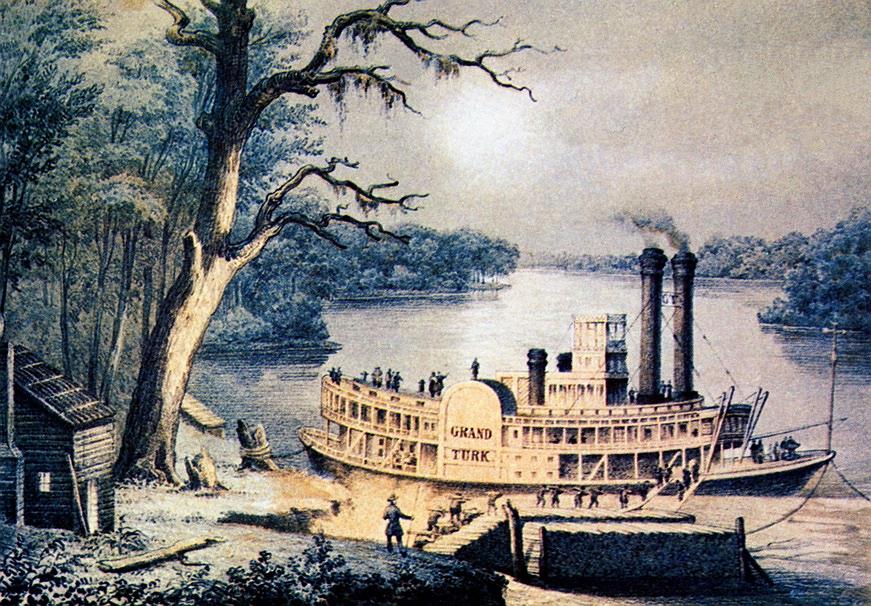
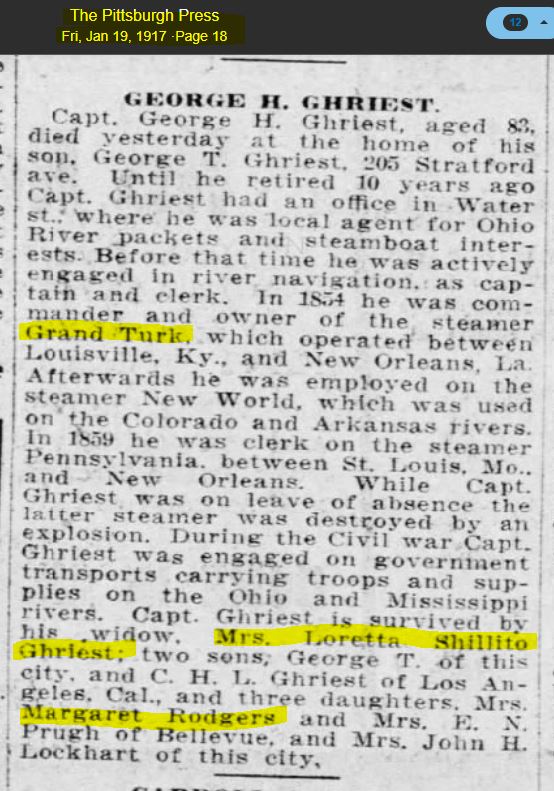
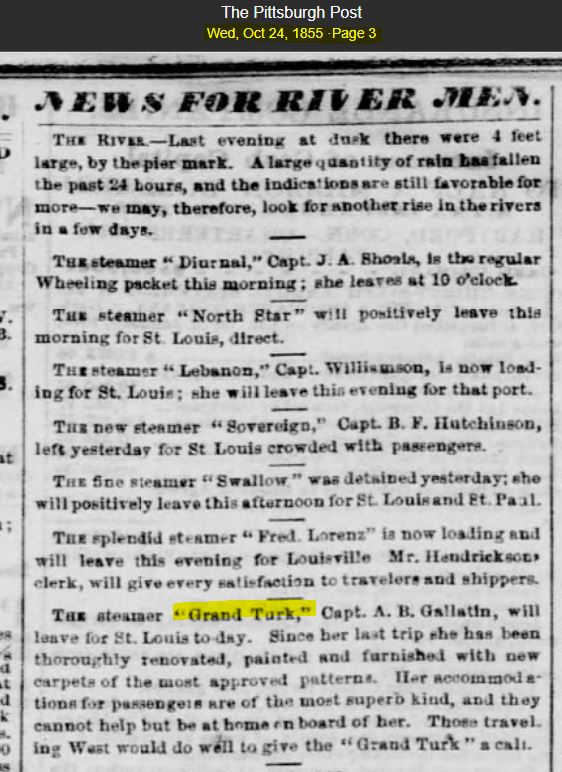
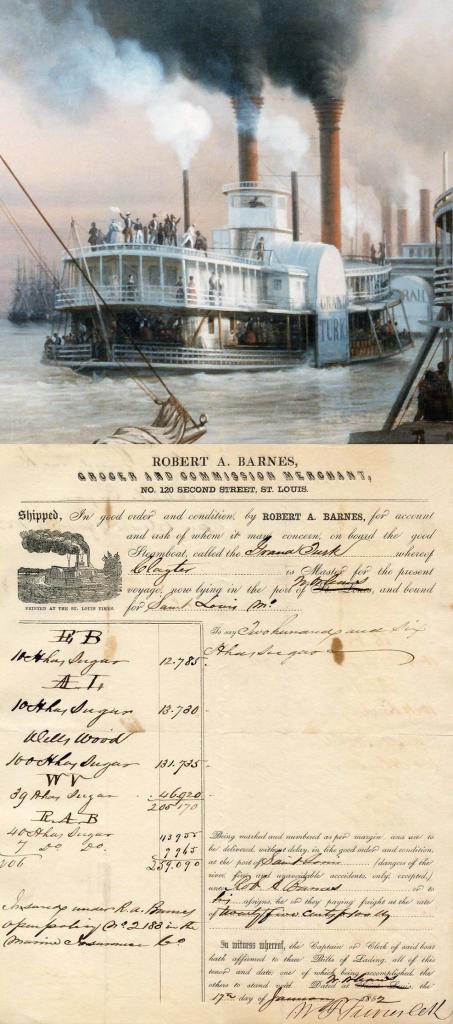
By 1854, George was already establishing himself in the riverboat business. According to his obituary, published in The Pittsburgh Press on January 19, 1917, he was both commander and owner of the steamer Grand Turk, which operated between Louisville, Kentucky, and New Orleans, Louisiana.
He subsequently worked aboard the steamer New World, navigating the Colorado and Arkansas rivers.
During the Civil War, Captain Ghriest was involved in government transportation, carrying troops and supplies along the Ohio and Mississippi rivers.
In his later years, he maintained an office on Water Street in Pittsburgh, where he served as a local agent for Ohio River packets and steamboat interests. He retired approximately ten years before his death in 1917.
Clearly, the rivers were much more than a means of earning a living for George Ghriest. They were his life’s work.
But one particular steamboat would forever distinguish his story from those of countless other riverboat captains.
The Ill-Fated
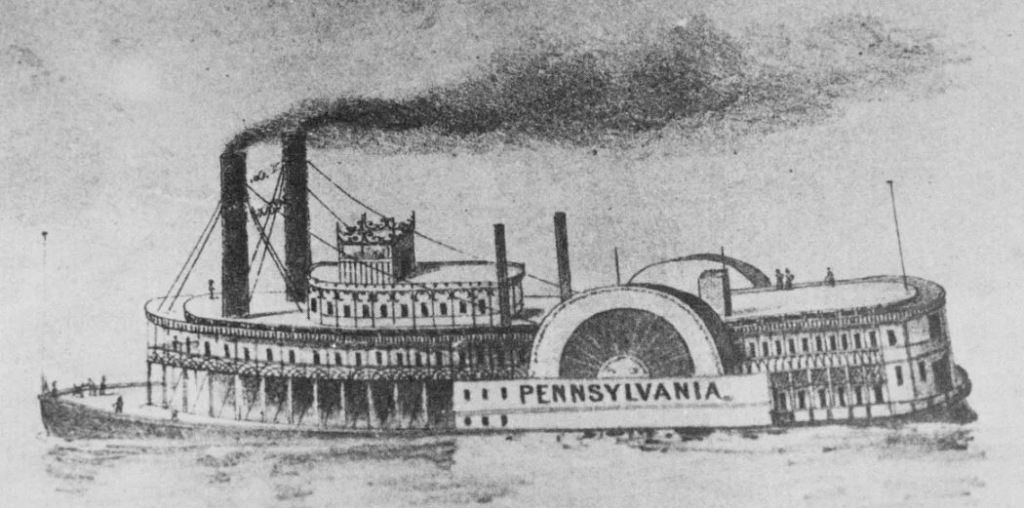
In June 1858, George Ghriest was employed as a clerk aboard the steamboat Pennsylvania, a large sidewheel vessel operating between St. Louis, Missouri, and New Orleans, Louisiana.
Fortunately for George, he was on a leave of absence when the Pennsylvania embarked upon what would become its final voyage.
On the morning of June 13, 1858, near Ship Island on the Mississippi River, approximately sixty miles below Memphis, Tennessee, the vessel suffered a catastrophic boiler explosion.
Four of its eight boilers exploded, destroying much of the forward section of the steamboat. Passengers and crew members were thrown into the river, while others suffered terrible burns from scalding steam.
Fire subsequently engulfed the wreckage.
Approximately 160 people lost their lives in what became one of the most devastating steamboat disasters of its era.
And had George Ghriest not been on leave, he might very well have been among them.
Interestingly, his 1917 obituary incorrectly identifies the year of the Pennsylvania disaster as 1859. Contemporary historical accounts establish that the explosion occurred on June 13, 1858.
That single year makes an enormous difference to our family story.
An Unexpected Connection to Mark Twain
Among those aboard the Pennsylvania on that terrible morning was a young man named Henry Clemens.
Henry was the younger brother of Samuel Langhorne Clemens, who would eventually become world-famous under his pen name, Mark Twain.
Samuel had worked aboard the Pennsylvania as a trainee riverboat pilot and had helped his younger brother obtain a position as a mud clerk, an entry-level job that offered opportunities for advancement.
Just days before the explosion, Samuel left the vessel following a disagreement with another pilot, William Brown.
Henry remained aboard.
When the boilers exploded on June 13, Henry suffered devastating injuries. Although he survived the initial disaster, he was severely burned and had inhaled scalding steam.
Samuel hurried to Memphis to be at his brother’s bedside.
Despite the efforts of those caring for him, Henry died on June 21, 1858, just eight days after the explosion. He was only nineteen years old.
The tragedy deeply affected Samuel Clemens, who would later recount the disaster in his book Life on the Mississippi.
And it is extraordinary to consider that Mark’s ancestor, George Ghriest, had worked aboard the very same steamboat as Henry Clemens.
Two young men whose lives intersected through their employment on the Mississippi River experienced dramatically different fates.
Henry Clemens lost his life.
George Ghriest, absent from the vessel, survived.
The Daughter Who Might Never Have Been Born
Now comes the part of this story that I find most remarkable.
George Ghriest’s daughter, Margaret Jane “Maggie” Ghriest, was born in 1859, the year following the explosion.
Based on her reported birth date of March 31, 1859, Maggie was likely conceived in early July 1858, approximately three to four weeks after the Pennsylvania disaster.
Think about that for a moment.
Had George Ghriest been aboard the Pennsylvania on June 13, 1858, and numbered among those who perished, his daughter Maggie would almost certainly never have been conceived.
And that is where this story becomes deeply personal.
Maggie would eventually marry into the Rogers family and become the mother of David Clinton Rogers II (1888–1962).
David’s daughter, Elizabeth Ann “Betty” Rogers (1924–1984), would become the mother of my husband
George Ghriest → Margaret Jane Ghriest → David Clinton Rogers II → Elizabeth Ann Rogers → my husband.
Five generations connected by a thread that might easily have been severed on a June morning in 1858.
Without Maggie, there would have been no David Clinton Rogers II. Without David, there would have been no Betty Rogers. And without Betty, there would have been no husband and ultimately, our two sons.
Of course, we can never know with certainty what might have happened had George been aboard that steamboat. But the timing is extraordinary.
Just weeks separated one of the Mississippi River’s deadliest steamboat disasters from the likely conception of a daughter whose descendants would eventually become my husband’s family.
A Family’s Brush with Fate
Captain George Holmes Ghriest lived another fifty-eight years after the Pennsylvania disaster, dying on January 18, 1917, at the age of eighty-two.
His obituary recorded a long career on America’s waterways, including ownership of the Grand Turk, service during the Civil War, and decades devoted to river transportation.
Yet among all those accomplishments, it was one brief sentence about his absence from the Pennsylvania that caught my attention.
What might have seemed like a minor detail in an obituary published nearly 110 years ago turned out to be the beginning of an extraordinary family discovery.
I often think about how many people research their ancestors by looking for the significant events in their lives: births, marriages, deaths, occupations, and military service.
But sometimes the most consequential event is the one that never happened.
A ship George Ghriest did not board.
A disaster he did not experience.
A daughter who, just weeks later, would begin her journey into the world.
And generations later, a husband whose very existence may trace back to one fortunate leave of absence.
That, to me, is what makes genealogy so fascinating.
We aren’t simply researching people who lived before us.
We’re discovering just how close we may have come to never being here at all.


Click the link below to read the letter Samuel Clemens (Mark Twain) sent to his sister after the death of their brother Henry aboard the Pennsylvania steamboat.
https://theamericanreader.com/18-june-1858-mark-twain-to-mary-e-clemens/


Leave a Reply