
Sometimes I find history when I’m not looking for it.
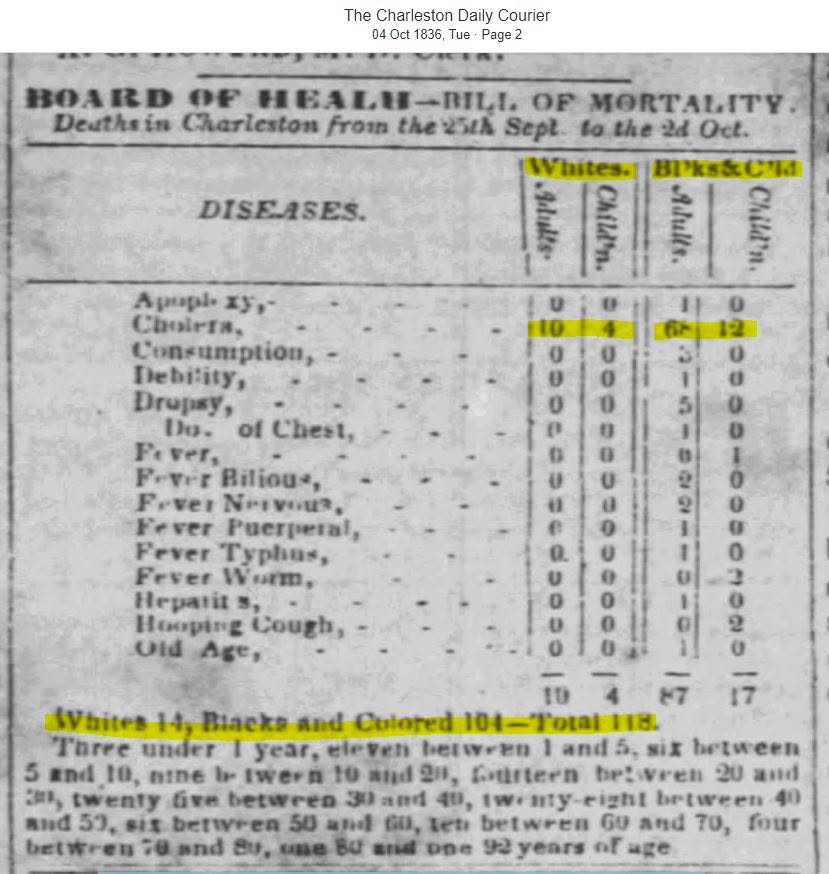
While searching old newspaper archives for something entirely unrelated, I came across this report published in The Charleston Daily Courier on October 4, 1836. It is a mortality report from the Charleston (South Carolina) Board of Health, and what gave me pause was not simply the number of deaths – it was the period of time represented.
One week.
Between September 25 and October 2, 1836, 118 people died in Charleston. Fourteen were recorded as White and 104 as Black. Cholera alone claimed 26 lives that week – 22 Black residents and four White residents.
The terminology in records from this period requires some care. Charleston’s death records distinguished between people identified as White, Black, or ‘Colored’, while a separate designation recorded whether a person was free or enslaved. So we cannot assume that every Black person represented in this newspaper report was enslaved.
What we can see is an extraordinary racial disparity compressed into just seven days. Behind those columns are 118 individual people living in the same city, but certainly not living under the same circumstances. Disease, poverty, sanitation, housing, access to resources and, above all, the institution of slavery shaped life and death in antebellum Charleston.
It is easy to skim past a table of numbers in a 190-year old newspaper. This one deserved a pause and reflection.


Leave a Reply