
Sometimes the smallest pieces of the historical record are the hardest to look at.
While listening to the audiobook “The Calamity Club” by Kathryn Stockett, I encountered a reference to dogs used to track enslaved people who attempted to escape. I knew about slave catchers, of course, but had never given much thought to the dogs they sometimes used – or realized that newspapers of the time openly referred to them by the horrifying term “Negro dogs”.
That was enough to send me searching through nineteenth century newspapers.
What I found was worse than I expected.
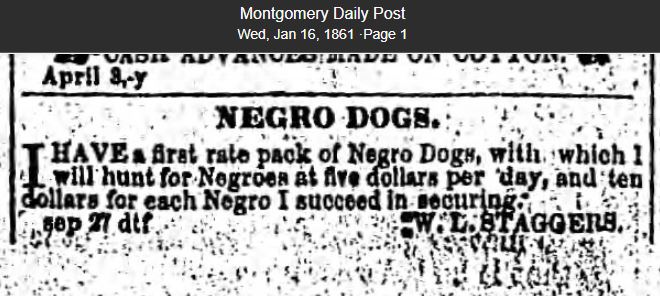
In one classified ad, the advertiser announced that he had a “first rate pack of Negro Dogs” and offered their services for hunting Black people at “five dollars per day”, with an additional charge for each person successfully captured.
Five dollars a day.
There was no attempt to disguise what was being offered. Someone owned a pack of dogs used to hunt human beings, and their services were advertised in the local newspaper at a daily rate.
Then I found another advertisement.
This one appeared in Alabama’s Southern Democrat in 1859. A man named Samuel T. Lowry announced that he had “as fine a pack of NEGRO DOGS as can be found in the State.”
Lowry claimed 18 years of experience and apparently believed that experience entitled him to “public support and confidence.” Then he published his price list.
Five dollars per day for hunting.
Twenty dollars for catching an enslaved person who had neither a gun nor a horse.
Double the rate if the person had a gun or a horse.
And then came the sentence that stopped me cold.
“Half grown boys and women half price.”
Women and children.
Half price.
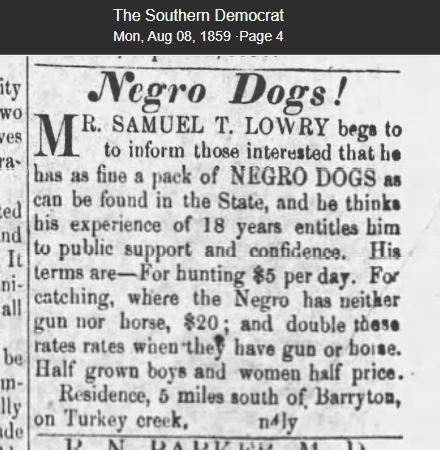
It is difficult to comprehend the coldness of those words. Human beings attempting to escape bondage had been reduced to categories on a price sheet. Men had one value. Women and boys another.
This was a business.
And it was advertised openly.
Then, while continuing through the newspapers, I found something that made those advertisements even more revealing.
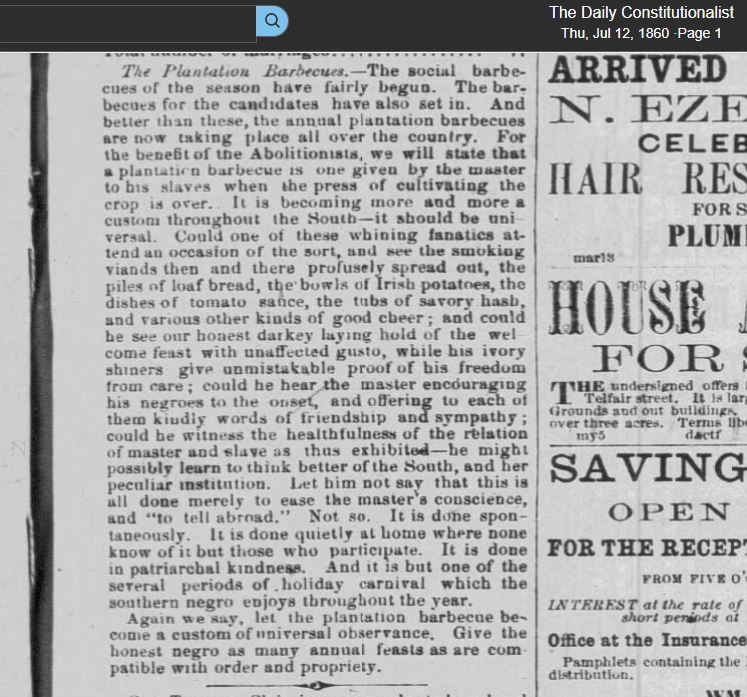
On July 12, 1860, The Daily Constitutionalist of Augusta, Georgia published an article titled “The Plantation Barbecues”.
The writer described barbecues supposedly given by enslavers for enslaved people after the cultivation of the crops were finished. There were Irish potatoes, tomato sauce, bread, meat and other food. The article described enslaved people enthusiastically eating while the enslaver offered them “kindly words of friendship and sympathy.”
And from this scene, the writer drew an astonishing conclusion.
If one of the ‘whining fanatics” (abolitionists) could attend such a barbecue, the article suggested, he would come to think better of the South and slavery – what the writer called the South’s “peculiar institution.”
The article went even further, suggesting that such a scene demonstrated the “beautifulness of the relation of master and slave.”
Beautifulness.
The writer apparently considered an occasional feast evidence that slavery was not the brutal institution its opponents claimed it was.
The article ended by encouraging enslavers to “Give the honest negro as many annual feasts as are compatible with order and propriety.”
And this is where these three newspaper clippings collide.
One newspaper asks its readers to admire the kindness of an enslaver providing food and offering friendly words to the people he owned.
The others advertise packs of dogs available for hire when those same people tried to get away.
These weren’t documents written decades later by people trying to make sense of what slavery had been. They appeared in newspapers while slavery was happening. They show us both the reality of the institution and the arguments people constructed to defend it.
The dog advertisements tell us something else, too. They tell us that enslaved people ran.
They risked capture, punishment and dogs because whatever supposedly existed in that “beautiful” relationship between enslaver and enslaved was not enough to make them want to remain in bondage.
Old newspapers have a way of stripping away the comfortable distance between us and history. Sometimes what survives isn’t a famous speech or a battlefield photograph. Sometimes it’s an advertisement, tucked between the ordinary business of everyday life.
Five dollars a day to hunt.
Twenty dollars to capture.
Women and boys half price.
And somewhere else, a newspaper assuring its readers that the relationship between enslaver and enslaved was beautiful.
But if the relationship between master and enslaved was so “beautiful”, why did they need packs of dogs to keep people from escaping it?


Leave a Reply