
Some of my favorite genealogy discoveries are the documents that let me see beyond the basic facts of an ancestor’s life. The 1889 letter below from Almon Hunt is one of those treasures. Rather than simply telling me where the family lived or when they moved, Almon tells me what he actually remembered – the places he saw, the events he witnessed, the people he knew, and even the stories that were still being told within the family. The amount of details he preserved is astonishing.
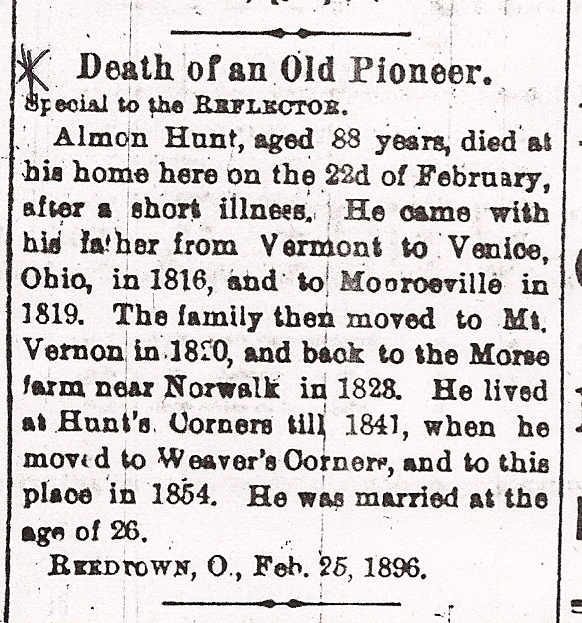
In May 1889, 81-year old Almon Hunt sat down to record memories of a life that began in Vermont in 1808. His wife, Cynthia Ann ‘Cynthianna’ (Walker) Hunt was my 3X great aunt and through Almon’s recollections I get something extraordinarily valuable: a glimpse into the world in which my Walker family lived.
Almon remembered enormous Vermont snowstorms, his father’s work as a millwright, and the cartridge boxes his father made for soldiers during the War of 1812. He remembered his family leaving Vermont in 1815 and moving first to western New York, then boarding a small schooner in Buffalo and sailing across Lake Erie toward Ohio. When they stopped at Erie, Pennsylvania, people were celebrating the 4th of July and firing cannons. They arrived in Sandusky, Ohio a week later around July 11, 1816.
And according to Almon, Sandusky then consisted of only three or four small buildings.
Those are the details that fascinate me the most about genealogy. We learn about the westward migration, the War of 1812 and the settlement of Ohio as chapters in American history. But occasionally I find a document like this and realize that my own people weren’t standing somewhere outside that history.
They were living in the middle of it.
Almon’s account also contains the everyday human details that rarely make it into history books: mills built and lost, relatives arriving one after another, terrible illnesses and deaths in the early settlement – and even an uncle who apparently escaped from a log jail, returned to the family mills for several days to get his business affairs in order, and then headed west.
You simply cannot make this stuff up.
Because the original handwritten document can be difficult to read in places, I’ve included my full transcription below. More than 135 years after Almon wrote these words – and more than two centuries after many of the events he describes – they allow us to hear an old man’s memories of a world that was already disappearing when he put pen to paper.
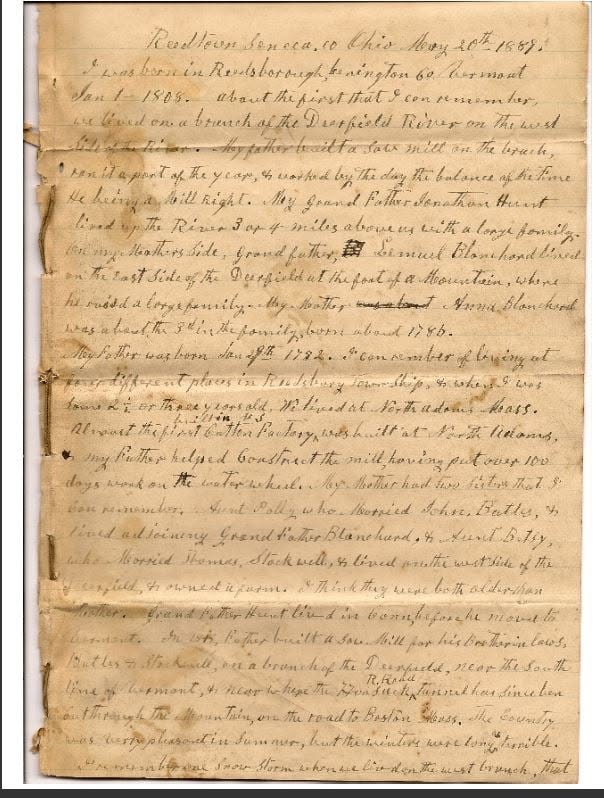
Reedtown Seneca Co., Ohio May 20th, 1889.
I was born in Reedsborough, Bennington Co., Vermont Jan 1 1808. About the first that I can remember we lived on a branch of the Deerfield River on the west side of the river. My father built a sawmill on the branch, ran it a part of the year, and worked by the day the balance of the time he being a mill right (sic). My grandfather, Jonathon Hunt lived up the river 3 or 4 miles above us with a large family. On my mother’s side, grandfather Samuel Blanchard lived on the east side of the Deerfield at the foot of a mountain where he raised a large family. My mother, Anna Blanchard was about the 3rd in a family born around 1786.
My father was born Jan. 29th 1782. I can remember of living at four different places in Reedsburg Township and when I was some 2-1/2 or three years old, we lived at North Adams, Mass. Almost the first cotton factory was built in US was built at North Adams. My father helped construct the mill, having put over 100 days work on the water wheel. My mother had two sisters that I can remember. Aunt Polly who married John Butler (?) and lived adjoining Grandfather Blanchard and Aunt Betsy who married Thomas Stockwell and lived on the west side of the Deerfield and owned a farm. I think they were both older than mother.
Grandfather Hunt lived in Connecticut before he moved to Vermont. In 1813 father built a sawmill for his brother-in-laws, Butler and Stockwell, on a branch of the Deerfield, near the south line of Vermont and near where the Housuck Railroad tunnel has since been cut through the mountain on the road to Boston, Mass.
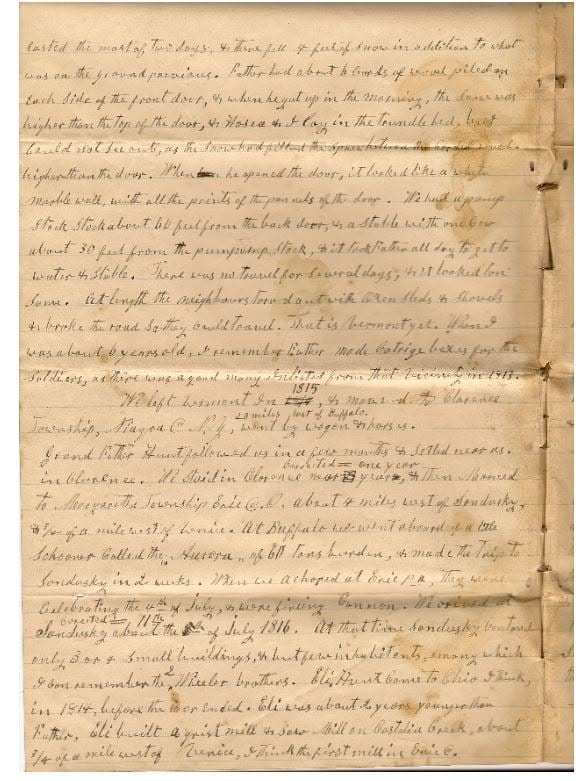
The county was very pleasant in summer, but the winters were long and terrible. I remember one snowstorm when we lived on the west branch that last the most of two days and there fell 4 feet of snow in addition to what was on the ground previous. Father had about 6 cords of wood piled on each side of the front door and when he got up in the morning, the snow was higher than the top of the door and (illegible) and I lay in the trundle bed, but could not see out as the snow had filled the space between the corded wood higher than the door. When he opened the door, it looked like a white marble wall, with all the points of the panels of the door. We had a pump stock stock (?) about 60 feet from the back door and a stable with one cow about 30 feet from the pumppump (?) stock and it took father all day to get to water and stable. There was no travel for several days and it looked (??) some.
At length the neighbors turned out with oxen sleds and shovels and broke the road so they could travel. That is Vermont yet. When I was about 6 years old I remember father made cartridge boxes for the soldiers as there was a good deal enlisted from that vicinity in 1813.
We left Vermont in 1815 and moved to Clarence Township, Niagara, NY 20 miles west of Buffalo, went by wagon and horses.
Grandfather Hunt followed us in a few months and settled near us in Clarence. We staid (sic) in Clarence near one year and then moved to Margaretta Township, Erie at O. about 4 miles west of Sandusky and 3/4 of a mile west of Venice (?). At Buffalo we went aboard of a little schooner called the ‘Aurora’, of 60 tons burden and made the trip to Sandusky in 2 weeks. When we anchored at Erie, PA they were celebrating the 4th of July and were firing cannon. We arrived at Sandusky about the 11th of July 1816.
At that time, Sandusky contained only 3 or 4 small buildings and but few inhabitants, among which I can remember the 2 Wheeler brothers. Eli Hunt came to Ohio I think in 1814 before the war ended. Eli was about 2 years younger than father.
Eli built a grist mill and saw mill on Castalia Creek about 3/4 of a mile west of Venice, I think the first grist mill in Erie @ O.
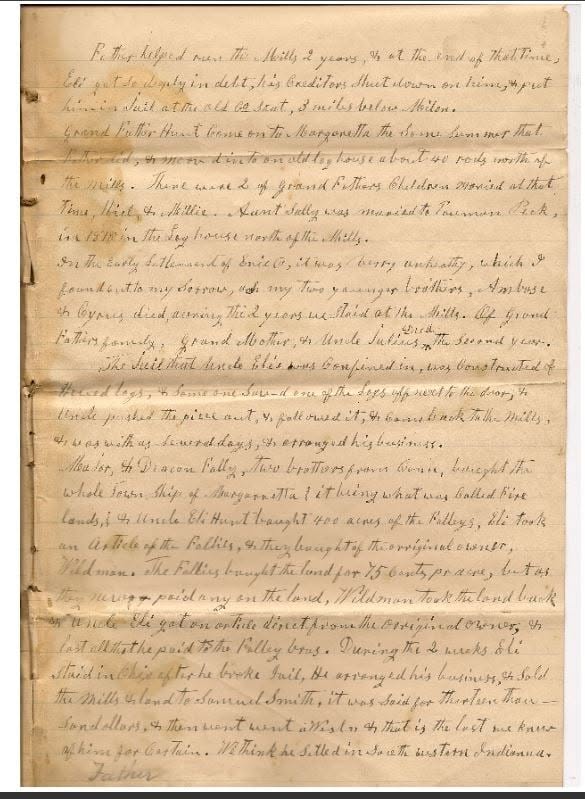
Father helped run the mills 2 years and at the end of that time, Eli got so deeply in debt, his creditors shut down on him and put him in jail at the old co. seat, 3 miles below Milan.
Grandfather Hunt came on to Margaretta that same summer that father did and moved into an old log house about 40 rods north of the mills. There were 2 of grandfather’s children married at that time, Hiel and Millie. Aunt Sally was married to Truman Peck in 1818 in the log house north of the mills.
In the early settlement of Erie @ O it was very unhealthy which I found out to my sorrow as my two younger brothers, Ambrose and Cyrus died during the 2 years we staid (sic) at the mills. Of grandfather’s family, grandmother and Uncle Julius died the second year.
The jail that Uncle Eli was confined in was constructed of hewed logs and someone sawed one of the logs off next to the door, and uncle pushed the piece out and followed it and came back to the mills and was with use several days to arrange his business.
Major and Deacon Folly, two brothers from (illegible) bought the whole township of Margaretta and it being what was called Firelands and Uncle Eli Hunt bought 400 acres of the Folley’s, Eli took an article of the Follies and they bought off the original owner Wildman. The Follies bough the land for 75 cents per acre, but as they never paid any on the land, Wildman took the land back and Uncle Eli got an article direct from the original owner and lost all that he paid to the Folley brothers.
During the 2 weeks Eli staid (sic) in Ohio after he broke jail, he arranged his business and sold the mills and land to Samuel Smith, it was said for thirteen thousand dollars and then went west and that is the last we knew of him for certain. We think he settled in southwestern, Indiana.


Leave a Reply