
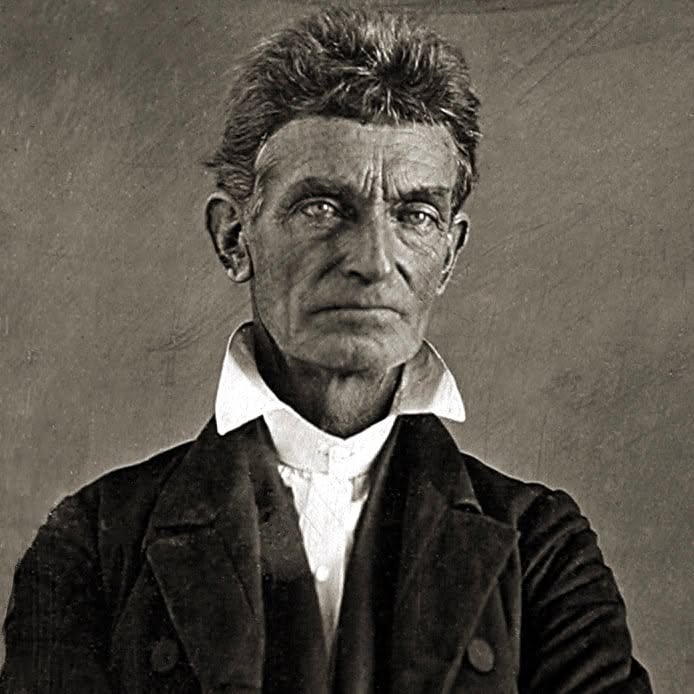
John Brown remains one of the most complicated figures in American history. A fierce abolitionist who came to believe slavery would never be destroyed peacefully, Brown was willing to use violence against those who defended it. In 1856, during the bloody conflict over whether Kansas would enter the Union as a free or slave state, Brown and several followers killed five pro-slavery men near Pottawatomie Creek.
His hatred of slavery, however, began decades earlier. Brown later recalled while still a boy, he witnessed an enslaved child about his own age being brutally beaten. The experience stayed with him and helped shape the uncompromising abolitionist he would eventually become.
Three years after the violence in Kansas, Brown attempted something far more ambitious.
On October 16, 1859, Brown and a small band of followers (including many of his sons) seized the federal armory at Harpers Ferry, Virginia, hoping to capture weapons and ignite a widespread uprising among enslaved people.
It failed.
U.S. Marines, commanded by Colonel Robert E. Lee, stormed the armory and captured Brown. He was tried for treason against Virginia, murder, and inciting a slave insurrection. He was convicted and sentenced to hang.
And this is where history does one of those things that makes me love it.
On December 2, 1859, John Brown was taken to the gallows in Charles Town, Virginia. Among the military forces assembled there were men whose names would soon become permanently intertwined with the Civil War.
Thomas J. Jackson – the future “Stonewall” Jackson – was there.
And among the spectators was a young actor named John Wilkes Booth.
Yes. That John Wilkes Booth.
Booth reportedly borrowed a militia uniform so he could accompany a Richmond militia company to Charles Town and witness Brown’s execution.
Less than six years later, on April 14, 1865, Booth would shoot President Abraham Lincoln at Ford’s theater.
John Brown, Stonewall Jackson, Robert E. Lee, and John Wilkes Booth – names we tend to encounter in completely different chapters of American history – all intersected in the events surrounding Harpers Ferry and Brown’s execution before the Civil War had even begun.
And that is your little bit of history you didn’t ask for.
In 2020, Showtime released a television mini-series “The Good Lord Bird ” starring Ethan Hawke as radical abolitionist John Brown. It follows Henry “Little Onion” Shackleford, a young enslaved boy in 1856 Kansas whom Brown mistakes for a girl, as they journey toward the 1859 raid on Harpers Ferry. For my fellow ‘Hamilton’ fans, Daveed Diggs plays Frederick Douglass.
While “The Good Lord Bird” is obviously not a truly factual account of John Brown, the Quentin Tarantino-ish feel of the movie is brilliant. So much so that I watched the entire series twice.


Leave a Reply